
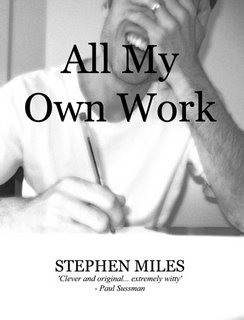
A belated update to the blog to say that my book is now available direct from publisher Thoughtcat's Lulu shop at only £7.50* plus p&p. This is down from the original price of £10.99.
And if you don't think £7.50 is reasonable, Thoughtcat is even offering a limited supply of copies for 'pay what you like', inclusive of p&p.
Impoverishedly,
Steve
* Due to a technical problem the price of the book is in US$ so the price in GBP is showing as a conversion. Therefore you may pay a few pence more than £7.50, but only a few pence (currently £7.54). You may ask why we don't just advertise the book for £7.54. The answer is it would just look silly.
Wednesday, January 21, 2009
Tuesday, January 16, 2007
All My Own Work in the local paper
I'm 'delighted' to hear from Thoughtcat that venerable local organ The Richmond & Twickenham Times reports this week on the story of All My Own Work's publication, under the headline 'Disgraced author's new offering'. There doesn't appear to be an online version of the story as yet, but Richard (or rather 'Ron' as the Times has it!) has done an excellent cut'n'paste job with the press cutting (are you sure we didn't work at the same company back in the nineties, Rich?) and has updated the 'Thought Cat' site with the (offending) article. Meanwhile, I'm going back to my sticky rice...
In disgrace,
Steve
In disgrace,
Steve

Sunday, December 24, 2006
Chapters Eight and Nine
A Christmas treat! Finally, as promised several aeons ago, here are some more sample chapters from the book. I've decided to skip the rest of Part 1 which was partially previewed here last year and go straight into Part 2, which (all bar the shouting) begins with...
Chapter Eight
When I left school and, shortly afterwards, home, all I wanted to do with my life was write. For years I lived in bedsits and flatshares and other living spaces as economical as those compound nouns, moving around from town to town and job to job, rarely caring what I did or how I lived as long as I had a big enough room for a bed, a desk and a chair, and enough cash for my rent, food and cigarettes. I wasn't a career kind of guy; the only career I was interested in was writing, and that wasn't something you made a career of, it was just something you did. Mine was a simple, rather naive lifestyle, and even now I sometimes catch myself feeling nostalgic for it, but it really wasn't as romantic as it might sound: the rooms were rank, the jobs were dreary and the hours, whether I was writing or not, were long and heavy.
It wouldn't've been so bad, perhaps, if I'd been the sort of writer whom women found irresistible, but I wasn't, and never will be: without wishing to go into great detail about my love-life before I met Fon (the details of it after I met her are, I should think, quite enough), it was, I'd say, about average, even taking into account a later start in these matters than I would have liked and some very lean periods where the closest I got to swapping bodily fluids with anyone was using the communal bath after a fellow tenant. As you might expect of a lonesome writer- manqué who generally preferred to spend the evenings indoors with a bottle of vino and a Beatles album than trying his luck in a bar, love and sex for me were far higher on quality than on quantity, boiling down to maybe half a dozen sporadic affairs which lasted between a couple of months and a couple of years, each both ordinary and wonderful in their own ways and all of them ending about as naturally and amicably as is possible between men and women.
If there was one thing which got me through those years it was a book – The Medusa Frequency, a novel by Russell Hoban, an American-born writer long since expatriated to these shores. I've often thought of it as my Desert Island Discs book, although whether I'll actually end up on the show is a matter still under discussion at the BBC. Apart from my pendant of Luan Po Tuad, this was the only other treasured possession I salvaged from my home before I ran away.
I was in my late teens when the book came out. I first read about it in the Literary Review, a slightly pretentious magazine I subscribed to in those days in the belief it was what you did if you were serious about becoming a writer. The review was what you might call enthusiastic, featuring a photo of the author – a short, round, sixty-ish man with a white beard and no moustache – captioned HOBAN: IS HE THE GREATEST WRITER IN THE WORLD? I wasn't used to books doing to me what this one did; I'd read a few great ones at school and college – The Lord of the Flies, Great Expectations, Heart of Darkness – but there was still something black-and-white to me about those classics. The Medusa Frequency was the first book I read which seemed to have been written in colour. No novel before or since has inspired me in the fundamental and profound way that this one did: apart from being beautifully written, it was concerned with what were already the two central issues in my life – writing and relationships. In that order. A decade and a half later, I've lost count of the number of times I've read it, but it does the same thing to me every time: it makes me feel that anything is possible – with regard to writing, anyway. It's more realistic about relationships.
In the book, Herman Orff, a London-based comic-book illustrator and sometime novelist, is trying to overcome his writer's block and get his third novel off the ground. He is obsessed with certain images and stories, chief among them the Greek mythological characters The Kraken – with whom he sits up late at night having 'conversations' at his word-processor – and Orpheus and Eurydice, as well as Vermeer's famous Girl with a Pearl Earring portrait. The Vermeer Girl in turn reminds him of Luise, the love of his life who left him several years before, after he was unfaithful to her. In an attempt to fire his imagination Herman undergoes an unusual brain-zapping technique for boosting creativity (a part I especially liked because it involved being linked up to a Fairlight music computer), following which he starts to hallucinate the dismembered, all-singing, all-storytelling head of Orpheus, which appears to him in the guises of various spherical objects – a football, a cabbage, a rock in the low-tide mud by the Thames. The head tells Herman his story: how he learnt to play the lyre, how he met Eurydice and they fell in love, and how he lost her forever when he looked back while retrieving her from the Underworld. Gradually the reasons for the failure of the love between Orpheus and Eurydice help Herman to understand what went wrong in his own relationship – as Luise puts it, she trusted him with the idea of her, and he lost it.
It's an optimistic story in the sense that Herman resolves his artistic problems and reaches some sort of peace with Luise, but she does end up lost to him forever. I don't think this is giving much away – I mean, it is the story of Orpheus and Eurydice, after all. Given this, as well as the ambiguity of whether or not Herman ever finds the third novel he was looking for, I suppose it's ironic that I should feel that this of all books has made me feel 'anything is possible'; it's not something I've really thought about until now. Anyway, throughout these lean years I used to go on long walks down by the Thames in Richmond, a picturesque town in Surrey I've always loved, and at times of particular anxiety, loneliness or plain and simple writer's block, I would go hunting along the towpath there for the Head of Orpheus. As you might expect, I had a number of fruitless searches before I found it.
It was February, just after dusk, the sky the rich, deep purple of a ripe black eye, the streetlamps buzzing their warm yellow in the air and glistening off the wet pavements. The tall young German who ran the café in one of the arches under Richmond Bridge was cleaning up and getting ready to close, the electric lights glowing yellow behind steamy windows. I looked over at the backs of the restaurants and hotels facing the river and thought again how they reminded me of Paris – they always had done, in fact, even before I'd visited the city. I walked on past the landmarks I knew by heart, the benches under the blossom trees, the expensive restaurant that had risen up a couple of years back from the ashes of a burnt-down pizza shack, and the kiosk, long fallen into disrepair, its peeling sign still saying REFRESHMENTS. Opposite the kiosk was a jetty used by the local boating people, and on this occasion I noticed floating beside it something I'd never seen before.
The river was running fast that evening, like a fully-opened bath tap, and bobbing in it was a dirty white spherical buoy, a bit larger than a football. Tethered fast to the jetty, it moved up and down a little in the current but it stayed more or less in that spot. As I watched, it rolled up out of the river and two round, white, shiny discs appeared on it in exactly the place a pair of eyes would be on a human face. I looked around and quickly realised the eyes were no more than the reflections of two streetlamps on either side of me, but I couldn't ignore the idea that the buoy was in fact my very own Head of Orpheus. I flashed a sad smile to myself at the thought of the book, at how good it and its author were and how useless – and, frankly, fey – I was. Why didn't things like that happen in real life? Why couldn't the real Head of Orpheus appear to me and help me write my Difficult Third Novel, or even my Difficult First Novel for that matter? God, you're hopeless, I thought (about myself, I mean, not God; I didn't have a problem with Him, it was me who had to sort my life out) – here you are trudging Lowry-like along the river again on another cold evening, always giving yourself some path to walk down, always looking for something that isn't there… the Head of Orpheus is in a book, it's a product of someone's imagination. Hoban – and, it should be said, the Head of Orpheus itself – would doubtless say that that doesn't make it less real, but, you know, it's been done. Get a life, Miles – get your own life!
I stared at the Buoy of Orpheus for several minutes, hanging on to the absurd hope that it would say something, that something, anything out of the ordinary would happen to get me out of the rut I was in. It was a crucial moment – things could surely only get worse if I found myself alone by the river willing a buoy to speak to me and nothing happened. At last, to my relief, a voice spoke to my mind. 'What are you after?' it said.
'Are you talking to me?' I replied, with my mind.
'I don't see anybody else standing around,' it said.
The voice was gruff and whatever it was was talking under its breath, like the bloke with the year-round bobble hat and hands like raw rump steaks who sold the Standard in Richmond high street. I looked around; I appeared to be alone.
'Is this the buoy speaking?' I said.
'If you like,' said the buoy. 'As I said, what are you after?'
'Nothing,' I said, suddenly even more self-conscious than usual.
'Liar,' it said. 'You're looking for answers.'
'Who isn't?' I said.
'Don't come the philosopher,' it said. 'Tell me what you're looking for.'
I thought hard. How was I supposed to answer the question? Now that I had the chance of asking, I had no idea what to say. The whole thing felt ridiculous. 'I don't know,' I sighed. 'Nothing... everything.'
'Hmm,' said the buoy. 'Tricky one. Well, to be honest, I think you need to clarify your question a little and come back when you've worked it out, hm?'
'Can't you just tell me something to be getting along with?' I said. 'Anything will do.'
'You're easily pleased, aren't you?' said the buoy.
'I don't know,' I said again. 'I guess.'
'I think I know what's going on here,' said the buoy, suggesting that if it had a chin it would be scratching it. 'You're bored, uninspired, maybe even a little desperate, no? You think you've come to the limits of yourself, and you want some reassurance that there's more to you than meets the eye at the moment.'
'Yes,' I said. 'That's it. That's very perceptive.'
'Well,' it sighed, 'there's not much I can say, really... just hang on in there, keep an eye out and let it happen. It'll come to you.'
'What'll come to me?' I said. 'A story? A woman?'
'Probably,' it said.
'Which?' I said. 'When? How?'
'Just keep an eye out. It'll be there. That's all I can say.'
'Is that it? Is that the answer I was looking for?'
'What did you expect,' said the buoy, 'a miracle? Sorry, I'm a bit short on those at the moment. Should have some in with the Friday delivery. Put your name down for one if you like.'
'Oh, go fish,' I said.
'That's an idea,' said the buoy, and promptly vanished under a particularly strong current.
I expected the experience to depress me even more, but the next day I woke up in decisive mood. Bugger the idea of waiting for something to happen, I thought: if writing and relationships were beyond my control, I should at least find a job I enjoyed and a decent place to live. Tipping a cockroach out of the window with a copy of the Media Guardian, I noticed an advert for a vacancy with a press cuttings agency near London Bridge; I'd never thought about that sort of work before, but I found myself applying for it anyway. I was invited for an interview, did a couple of tests to see how fast I could read and cut up newspaper articles, and within a week I was doing it for a living. The work was repetitive but easy, and the people and atmosphere were the best I'd known in any job: we were all in our twenties, we could wear what we liked, and, as long as we got the job done, we could work whatever hours we wanted. To cap it all, the firm rewarded hard (for which read 'dogged') work with regular pay rises, and after a year or so, for the first time in my life I was both doing a job I liked and earning enough to raise a mortgage.
When people asked me what working for a press cuttings agency involved, I'd tell them it was like scrap-books for grown-ups, and even that was stretching it. A client, normally a company although sometimes an individual, is looking for 'search terms' – mentions of companies (themselves, their competitors, firms they invest in, their own clients) or subjects (telecommunications, instant coffee, depression, condoms) in various print contexts. These include the national press ( The Guardian, The Independent), the regional press (The Yate & Sodbury Gazette, The Framley Examiner), general magazines (Esquire, Cosmopolitan), trade magazines (The Grocer, Capitalist Bastard Weekly ), and, these days, although not so much when I first joined the firm, the internet and news agencies (FT.com, Reuters). A 'reader' scans through these publications for the desired mentions, and when one is found, he cuts out the whole article it appeared in, arranges it neatly with scissors and glue onto A4 paper, photocopies it, puts it in the client's tray, and at the end of the day sends it out to the client in a plain brown envelope. Of all the jobs I ever had, never was there one with a more (unintentionally) ironic job title than 'reader': the stack of publications you had to 'read' in a day for the thousands of search terms required by the hundreds of clients meant you never had time to actually read anything. I imagine it was slightly more difficult than being a judge of a literary award.
I was slicing up a copy of Time Out one afternoon (something I'd often done in an amateur capacity, but to be paid for it was sublime) when I came across a tiny advert for a one-bedroomed flat in Twickenham, a suburb in south-west London that probably wouldn't be known about at all outside the immediate area were it not for the international rugby ground. The flat turned out to be above a flower shop in a high street on the less exclusive side of Richmond Bridge, literally just across the water from my favourite town, and about ten minutes' walk from the buoy I was still consulting, oracle-like, on a regular basis, even if its answers were mostly the same every time. Whimsical as it may be, I couldn't rid myself of the idea that this was somehow meant to have happened. Although the flat was draughty, damp, uncarpeted, noisy and dusty and had a boiler that clanked for England and a short lease, it was also very cheap – these were the mid-nineties, before London property prices spiralled out of the reach of people like me – and I knew from the moment I first viewed it that it would be mine: my mortgage would come through, there would be no other bidders and no delays; the flat had my name on it. I could settle down there and, pushing thirty as I was, finally begin to begin my life.
Yeah, I was happy there for a long time... letting it get repossessed was probably the second stupidest thing I ever did.
Chapter Nine
Another reason I fell in love with that flat was that it made me nostalgic for growing up above Mum and Dad's grocery shop, way over on the other side of Surrey. If I close my eyes and think back to my childhood, I am invariably sitting in the flat after school, watching TV and eating toast, alone but for the muffled conversation and laughter of the customers and staff filtering warmly up from below. That said, the first-floor position was pretty much where the local comparisons ended: although my neighbouring flats were similar in that they were generally occupied by the white, middle-class and ethnically English, the local Twickenham shops were far more cosmopolitan than those I'd known as a child: here I could have my hair cut by a Greek Cypriot, buy my newspaper from a Sri Lankan, get my groceries from a French deli and fresh-baked croissants from a Lebanese café. At times it didn't feel like a suburb at all, but more like a budget Soho.
Something else that was good about living on a high street was that the window was a permanent entertainment. I'd spend hours sitting there watching all of life walking, running, driving, cycling, shuffling, muttering, snogging, yelling and screaming past. For a single man and a struggling writer, that front window was a panacea, providing distraction when I was bored, inspiration when I was blocked and company when I was lonely. And even when the street quietened down in the evenings, it seamlessly passed on the baton of activity to the restaurant directly opposite my flat.
When I first moved in, the restaurant was an Italian called Mamma's. I used to do my writing at the dining table I'd parked right by the lounge window, and from there, on slow evenings for both of us, I'd sit and watch the owner, a bone-thin man with a lugubrious grey moustache, while away his life at the bar smoking cigarettes and drinking red wine. When the weather was cold and Mamma's was busy, the windows would steam up and all you could see were the flickerings of candles on tables like a misty garden filled with dewy blooms of light. Sadly, the food itself was less inspiring, as I found out on the only occasion I ate there, but even if it wasn't a great restaurant, Mamma's was without a doubt the nicest feature of my flat, and its warmth kept me going through three or four years of living alone – a part-time, on-off, live-out girlfriend notwithstanding – and the eternal struggle to write.
One evening I came home from work to find Mamma's windows whitewashed and a notice up saying LEASE FOR SALE. I remember feeling as if I'd been dumped by a lover – and then reflecting on the sad fact that Mamma's was as close as I'd been to sex in ages (the part-time girlfriend having by now resigned entirely). It was winter, and the months that passed while the landlord tried to find a new tenant were as bleak as any I'd ever known – even in my New Malden period, where McDonalds was as exotic as anything got. Give me a naff restaurant that's open for business over whitewashed windows any day of the week.
When the restaurant finally reopened the following spring, the whole street seemed to breathe a sigh of relief. Given the variety of shops and nationalities in the area, I suppose I shouldn't have been as surprised as I was when Mamma's was reborn as a Thai restaurant, but this was still slightly before Thai places started opening everywhere, and in all honesty I'd never given a second thought to the country. I'd never eaten Thai food at that time, couldn't name a single dish, and if anyone had asked me even to name Thailand's capital or find it on a map, I think I'd've been lost. Geography, beyond France anyway, had never been much discussed at the Miles family dinner table; in retrospect, what passed for my appreciation of Thai history and culture had been formed on languid Sunday afternoons in distant, hazy childhood watching Yul Brynner twirl Deborah Kerr around the floor in The King and I, as well as Walt Disney's bloody Siamese cats duet, and in both cases I wasn't even conscious that Thailand and Siam were the same thing. The Thai Garden, as the restaurant was called, was therefore exotic, but it was exotica tinged with confusion – a little like a certain relationship I was to have some time later.
As I watched the curious new sign with its curly lettering replace the old Mamma's hoarding, I wondered what the food would be like and how long the place would last. To my surprise, it was soon full every night, and when I went down with Tim, an old mate, and a couple of friends from work one evening, we found from the quality of the cooking that the novelty factor was by no means the only attraction. Even better, the customers and staff all seemed young and alive – and playful. I was at home cooking dinner one night, and glancing idly out the window (the cooker was right next to it) I saw a whole table of people looking up, waving and smiling. I peered down the street in both directions to see what they might be looking at, but when I looked back at them I realised it was me they were waving to. I hadn't shaved, the kitchen needed a clean, and I was wearing a saggy old tee-shirt, but I smiled it off and raised my glass to them – earning myself a rapturous round of silent applause into the bargain.
After that night, I would be waved at by someone in the restaurant at least once a week. Even if the wavers and I were complete strangers, it was reassuring to know I wasn't just a figment of my own imagination, as living alone and writing for hours on end – even on a high street – often made me feel. My existence in three dimensions was officially confirmed when the staff began waving to me every evening. A particularly bold waitress with a hair-grip of the sort that David Beckham would later make famous started the routine, and before long they were all at it. The waitress would generally appear at the window at around seven o'clock, just as the staff rose from their meal and the restaurant opened for the evening service, and it got to the point where if I hadn't had a wave by five past, I'd be on the floor having a full-blown identity crisis. But this was rare, and they were always glad to see me when I ventured out from my kitchen and into the restaurant and, by implication, the real world.
Over the following year I developed something of an acquaintance with the hairgripped waitress, whose name was Aoy, and on one occasion I even asked her out for a drink, although it came to nothing because she was due to fly back to Thailand for three months the next day. As excuses went, it was better than many I'd heard, but my disappointment must have shown because she promised me she'd tell her replacement, an old friend from her home town, to make sure I was waved at regularly in her absence.
Aoy's promise cheered me up, but I forgot all about it until a few weeks later. It was a Sunday morning in July, just gone eleven, I was sitting in the lounge reading the papers and the Thai Gardeners were starting to turn up for the lunch service. I was vaguely aware that there was someone new among them, but as staff came and went fairly regularly I didn't pay much attention to her – until she came and sat in the front window and made a call on her mobile phone, that is.
I remember the moment well: a gentle breeze from the open window, a cup of filter coffee to hand, and on the stereo one of my favourite Sunday-morning records, John McLaughlin's Time Remembered. When I die and they cut me open, they'll find those exquisite acoustic guitar renditions of Bill Evans's jazz piano pieces running right through me like the word BRIGHTON in a stick of rock; I suppose on that basis it doesn't matter that that's another album I no longer own. The CD sleeve is imprinted on my mind equally vividly: a simple blue-toned monochrome photo of McLaughlin standing over a Spanish guitar laid on the lid of a grand piano. You couldn't see much of the room he was in, but the windows behind him were suggestive of the sort of living room where you could comfortably spend your life. The wood of both guitar and piano had been glazed and polished, so the reflections of the windows rhymed in the glassy surfaces of both instruments, soft but bright. The music always sounded to me like the way the light fell on that wood, and in that hot Sunday morning moment the new girl's cool face looked to me like that music.
(c) Stephen Miles 2006
To buy a copy of All My Own Work please go to www.thoughtcat.com
Chapter Eight
When I left school and, shortly afterwards, home, all I wanted to do with my life was write. For years I lived in bedsits and flatshares and other living spaces as economical as those compound nouns, moving around from town to town and job to job, rarely caring what I did or how I lived as long as I had a big enough room for a bed, a desk and a chair, and enough cash for my rent, food and cigarettes. I wasn't a career kind of guy; the only career I was interested in was writing, and that wasn't something you made a career of, it was just something you did. Mine was a simple, rather naive lifestyle, and even now I sometimes catch myself feeling nostalgic for it, but it really wasn't as romantic as it might sound: the rooms were rank, the jobs were dreary and the hours, whether I was writing or not, were long and heavy.
It wouldn't've been so bad, perhaps, if I'd been the sort of writer whom women found irresistible, but I wasn't, and never will be: without wishing to go into great detail about my love-life before I met Fon (the details of it after I met her are, I should think, quite enough), it was, I'd say, about average, even taking into account a later start in these matters than I would have liked and some very lean periods where the closest I got to swapping bodily fluids with anyone was using the communal bath after a fellow tenant. As you might expect of a lonesome writer- manqué who generally preferred to spend the evenings indoors with a bottle of vino and a Beatles album than trying his luck in a bar, love and sex for me were far higher on quality than on quantity, boiling down to maybe half a dozen sporadic affairs which lasted between a couple of months and a couple of years, each both ordinary and wonderful in their own ways and all of them ending about as naturally and amicably as is possible between men and women.
If there was one thing which got me through those years it was a book – The Medusa Frequency, a novel by Russell Hoban, an American-born writer long since expatriated to these shores. I've often thought of it as my Desert Island Discs book, although whether I'll actually end up on the show is a matter still under discussion at the BBC. Apart from my pendant of Luan Po Tuad, this was the only other treasured possession I salvaged from my home before I ran away.
I was in my late teens when the book came out. I first read about it in the Literary Review, a slightly pretentious magazine I subscribed to in those days in the belief it was what you did if you were serious about becoming a writer. The review was what you might call enthusiastic, featuring a photo of the author – a short, round, sixty-ish man with a white beard and no moustache – captioned HOBAN: IS HE THE GREATEST WRITER IN THE WORLD? I wasn't used to books doing to me what this one did; I'd read a few great ones at school and college – The Lord of the Flies, Great Expectations, Heart of Darkness – but there was still something black-and-white to me about those classics. The Medusa Frequency was the first book I read which seemed to have been written in colour. No novel before or since has inspired me in the fundamental and profound way that this one did: apart from being beautifully written, it was concerned with what were already the two central issues in my life – writing and relationships. In that order. A decade and a half later, I've lost count of the number of times I've read it, but it does the same thing to me every time: it makes me feel that anything is possible – with regard to writing, anyway. It's more realistic about relationships.
In the book, Herman Orff, a London-based comic-book illustrator and sometime novelist, is trying to overcome his writer's block and get his third novel off the ground. He is obsessed with certain images and stories, chief among them the Greek mythological characters The Kraken – with whom he sits up late at night having 'conversations' at his word-processor – and Orpheus and Eurydice, as well as Vermeer's famous Girl with a Pearl Earring portrait. The Vermeer Girl in turn reminds him of Luise, the love of his life who left him several years before, after he was unfaithful to her. In an attempt to fire his imagination Herman undergoes an unusual brain-zapping technique for boosting creativity (a part I especially liked because it involved being linked up to a Fairlight music computer), following which he starts to hallucinate the dismembered, all-singing, all-storytelling head of Orpheus, which appears to him in the guises of various spherical objects – a football, a cabbage, a rock in the low-tide mud by the Thames. The head tells Herman his story: how he learnt to play the lyre, how he met Eurydice and they fell in love, and how he lost her forever when he looked back while retrieving her from the Underworld. Gradually the reasons for the failure of the love between Orpheus and Eurydice help Herman to understand what went wrong in his own relationship – as Luise puts it, she trusted him with the idea of her, and he lost it.
It's an optimistic story in the sense that Herman resolves his artistic problems and reaches some sort of peace with Luise, but she does end up lost to him forever. I don't think this is giving much away – I mean, it is the story of Orpheus and Eurydice, after all. Given this, as well as the ambiguity of whether or not Herman ever finds the third novel he was looking for, I suppose it's ironic that I should feel that this of all books has made me feel 'anything is possible'; it's not something I've really thought about until now. Anyway, throughout these lean years I used to go on long walks down by the Thames in Richmond, a picturesque town in Surrey I've always loved, and at times of particular anxiety, loneliness or plain and simple writer's block, I would go hunting along the towpath there for the Head of Orpheus. As you might expect, I had a number of fruitless searches before I found it.
It was February, just after dusk, the sky the rich, deep purple of a ripe black eye, the streetlamps buzzing their warm yellow in the air and glistening off the wet pavements. The tall young German who ran the café in one of the arches under Richmond Bridge was cleaning up and getting ready to close, the electric lights glowing yellow behind steamy windows. I looked over at the backs of the restaurants and hotels facing the river and thought again how they reminded me of Paris – they always had done, in fact, even before I'd visited the city. I walked on past the landmarks I knew by heart, the benches under the blossom trees, the expensive restaurant that had risen up a couple of years back from the ashes of a burnt-down pizza shack, and the kiosk, long fallen into disrepair, its peeling sign still saying REFRESHMENTS. Opposite the kiosk was a jetty used by the local boating people, and on this occasion I noticed floating beside it something I'd never seen before.
The river was running fast that evening, like a fully-opened bath tap, and bobbing in it was a dirty white spherical buoy, a bit larger than a football. Tethered fast to the jetty, it moved up and down a little in the current but it stayed more or less in that spot. As I watched, it rolled up out of the river and two round, white, shiny discs appeared on it in exactly the place a pair of eyes would be on a human face. I looked around and quickly realised the eyes were no more than the reflections of two streetlamps on either side of me, but I couldn't ignore the idea that the buoy was in fact my very own Head of Orpheus. I flashed a sad smile to myself at the thought of the book, at how good it and its author were and how useless – and, frankly, fey – I was. Why didn't things like that happen in real life? Why couldn't the real Head of Orpheus appear to me and help me write my Difficult Third Novel, or even my Difficult First Novel for that matter? God, you're hopeless, I thought (about myself, I mean, not God; I didn't have a problem with Him, it was me who had to sort my life out) – here you are trudging Lowry-like along the river again on another cold evening, always giving yourself some path to walk down, always looking for something that isn't there… the Head of Orpheus is in a book, it's a product of someone's imagination. Hoban – and, it should be said, the Head of Orpheus itself – would doubtless say that that doesn't make it less real, but, you know, it's been done. Get a life, Miles – get your own life!
I stared at the Buoy of Orpheus for several minutes, hanging on to the absurd hope that it would say something, that something, anything out of the ordinary would happen to get me out of the rut I was in. It was a crucial moment – things could surely only get worse if I found myself alone by the river willing a buoy to speak to me and nothing happened. At last, to my relief, a voice spoke to my mind. 'What are you after?' it said.
'Are you talking to me?' I replied, with my mind.
'I don't see anybody else standing around,' it said.
The voice was gruff and whatever it was was talking under its breath, like the bloke with the year-round bobble hat and hands like raw rump steaks who sold the Standard in Richmond high street. I looked around; I appeared to be alone.
'Is this the buoy speaking?' I said.
'If you like,' said the buoy. 'As I said, what are you after?'
'Nothing,' I said, suddenly even more self-conscious than usual.
'Liar,' it said. 'You're looking for answers.'
'Who isn't?' I said.
'Don't come the philosopher,' it said. 'Tell me what you're looking for.'
I thought hard. How was I supposed to answer the question? Now that I had the chance of asking, I had no idea what to say. The whole thing felt ridiculous. 'I don't know,' I sighed. 'Nothing... everything.'
'Hmm,' said the buoy. 'Tricky one. Well, to be honest, I think you need to clarify your question a little and come back when you've worked it out, hm?'
'Can't you just tell me something to be getting along with?' I said. 'Anything will do.'
'You're easily pleased, aren't you?' said the buoy.
'I don't know,' I said again. 'I guess.'
'I think I know what's going on here,' said the buoy, suggesting that if it had a chin it would be scratching it. 'You're bored, uninspired, maybe even a little desperate, no? You think you've come to the limits of yourself, and you want some reassurance that there's more to you than meets the eye at the moment.'
'Yes,' I said. 'That's it. That's very perceptive.'
'Well,' it sighed, 'there's not much I can say, really... just hang on in there, keep an eye out and let it happen. It'll come to you.'
'What'll come to me?' I said. 'A story? A woman?'
'Probably,' it said.
'Which?' I said. 'When? How?'
'Just keep an eye out. It'll be there. That's all I can say.'
'Is that it? Is that the answer I was looking for?'
'What did you expect,' said the buoy, 'a miracle? Sorry, I'm a bit short on those at the moment. Should have some in with the Friday delivery. Put your name down for one if you like.'
'Oh, go fish,' I said.
'That's an idea,' said the buoy, and promptly vanished under a particularly strong current.
I expected the experience to depress me even more, but the next day I woke up in decisive mood. Bugger the idea of waiting for something to happen, I thought: if writing and relationships were beyond my control, I should at least find a job I enjoyed and a decent place to live. Tipping a cockroach out of the window with a copy of the Media Guardian, I noticed an advert for a vacancy with a press cuttings agency near London Bridge; I'd never thought about that sort of work before, but I found myself applying for it anyway. I was invited for an interview, did a couple of tests to see how fast I could read and cut up newspaper articles, and within a week I was doing it for a living. The work was repetitive but easy, and the people and atmosphere were the best I'd known in any job: we were all in our twenties, we could wear what we liked, and, as long as we got the job done, we could work whatever hours we wanted. To cap it all, the firm rewarded hard (for which read 'dogged') work with regular pay rises, and after a year or so, for the first time in my life I was both doing a job I liked and earning enough to raise a mortgage.
When people asked me what working for a press cuttings agency involved, I'd tell them it was like scrap-books for grown-ups, and even that was stretching it. A client, normally a company although sometimes an individual, is looking for 'search terms' – mentions of companies (themselves, their competitors, firms they invest in, their own clients) or subjects (telecommunications, instant coffee, depression, condoms) in various print contexts. These include the national press ( The Guardian, The Independent), the regional press (The Yate & Sodbury Gazette, The Framley Examiner), general magazines (Esquire, Cosmopolitan), trade magazines (The Grocer, Capitalist Bastard Weekly ), and, these days, although not so much when I first joined the firm, the internet and news agencies (FT.com, Reuters). A 'reader' scans through these publications for the desired mentions, and when one is found, he cuts out the whole article it appeared in, arranges it neatly with scissors and glue onto A4 paper, photocopies it, puts it in the client's tray, and at the end of the day sends it out to the client in a plain brown envelope. Of all the jobs I ever had, never was there one with a more (unintentionally) ironic job title than 'reader': the stack of publications you had to 'read' in a day for the thousands of search terms required by the hundreds of clients meant you never had time to actually read anything. I imagine it was slightly more difficult than being a judge of a literary award.
I was slicing up a copy of Time Out one afternoon (something I'd often done in an amateur capacity, but to be paid for it was sublime) when I came across a tiny advert for a one-bedroomed flat in Twickenham, a suburb in south-west London that probably wouldn't be known about at all outside the immediate area were it not for the international rugby ground. The flat turned out to be above a flower shop in a high street on the less exclusive side of Richmond Bridge, literally just across the water from my favourite town, and about ten minutes' walk from the buoy I was still consulting, oracle-like, on a regular basis, even if its answers were mostly the same every time. Whimsical as it may be, I couldn't rid myself of the idea that this was somehow meant to have happened. Although the flat was draughty, damp, uncarpeted, noisy and dusty and had a boiler that clanked for England and a short lease, it was also very cheap – these were the mid-nineties, before London property prices spiralled out of the reach of people like me – and I knew from the moment I first viewed it that it would be mine: my mortgage would come through, there would be no other bidders and no delays; the flat had my name on it. I could settle down there and, pushing thirty as I was, finally begin to begin my life.
Yeah, I was happy there for a long time... letting it get repossessed was probably the second stupidest thing I ever did.
Chapter Nine
Another reason I fell in love with that flat was that it made me nostalgic for growing up above Mum and Dad's grocery shop, way over on the other side of Surrey. If I close my eyes and think back to my childhood, I am invariably sitting in the flat after school, watching TV and eating toast, alone but for the muffled conversation and laughter of the customers and staff filtering warmly up from below. That said, the first-floor position was pretty much where the local comparisons ended: although my neighbouring flats were similar in that they were generally occupied by the white, middle-class and ethnically English, the local Twickenham shops were far more cosmopolitan than those I'd known as a child: here I could have my hair cut by a Greek Cypriot, buy my newspaper from a Sri Lankan, get my groceries from a French deli and fresh-baked croissants from a Lebanese café. At times it didn't feel like a suburb at all, but more like a budget Soho.
Something else that was good about living on a high street was that the window was a permanent entertainment. I'd spend hours sitting there watching all of life walking, running, driving, cycling, shuffling, muttering, snogging, yelling and screaming past. For a single man and a struggling writer, that front window was a panacea, providing distraction when I was bored, inspiration when I was blocked and company when I was lonely. And even when the street quietened down in the evenings, it seamlessly passed on the baton of activity to the restaurant directly opposite my flat.
When I first moved in, the restaurant was an Italian called Mamma's. I used to do my writing at the dining table I'd parked right by the lounge window, and from there, on slow evenings for both of us, I'd sit and watch the owner, a bone-thin man with a lugubrious grey moustache, while away his life at the bar smoking cigarettes and drinking red wine. When the weather was cold and Mamma's was busy, the windows would steam up and all you could see were the flickerings of candles on tables like a misty garden filled with dewy blooms of light. Sadly, the food itself was less inspiring, as I found out on the only occasion I ate there, but even if it wasn't a great restaurant, Mamma's was without a doubt the nicest feature of my flat, and its warmth kept me going through three or four years of living alone – a part-time, on-off, live-out girlfriend notwithstanding – and the eternal struggle to write.
One evening I came home from work to find Mamma's windows whitewashed and a notice up saying LEASE FOR SALE. I remember feeling as if I'd been dumped by a lover – and then reflecting on the sad fact that Mamma's was as close as I'd been to sex in ages (the part-time girlfriend having by now resigned entirely). It was winter, and the months that passed while the landlord tried to find a new tenant were as bleak as any I'd ever known – even in my New Malden period, where McDonalds was as exotic as anything got. Give me a naff restaurant that's open for business over whitewashed windows any day of the week.
When the restaurant finally reopened the following spring, the whole street seemed to breathe a sigh of relief. Given the variety of shops and nationalities in the area, I suppose I shouldn't have been as surprised as I was when Mamma's was reborn as a Thai restaurant, but this was still slightly before Thai places started opening everywhere, and in all honesty I'd never given a second thought to the country. I'd never eaten Thai food at that time, couldn't name a single dish, and if anyone had asked me even to name Thailand's capital or find it on a map, I think I'd've been lost. Geography, beyond France anyway, had never been much discussed at the Miles family dinner table; in retrospect, what passed for my appreciation of Thai history and culture had been formed on languid Sunday afternoons in distant, hazy childhood watching Yul Brynner twirl Deborah Kerr around the floor in The King and I, as well as Walt Disney's bloody Siamese cats duet, and in both cases I wasn't even conscious that Thailand and Siam were the same thing. The Thai Garden, as the restaurant was called, was therefore exotic, but it was exotica tinged with confusion – a little like a certain relationship I was to have some time later.
As I watched the curious new sign with its curly lettering replace the old Mamma's hoarding, I wondered what the food would be like and how long the place would last. To my surprise, it was soon full every night, and when I went down with Tim, an old mate, and a couple of friends from work one evening, we found from the quality of the cooking that the novelty factor was by no means the only attraction. Even better, the customers and staff all seemed young and alive – and playful. I was at home cooking dinner one night, and glancing idly out the window (the cooker was right next to it) I saw a whole table of people looking up, waving and smiling. I peered down the street in both directions to see what they might be looking at, but when I looked back at them I realised it was me they were waving to. I hadn't shaved, the kitchen needed a clean, and I was wearing a saggy old tee-shirt, but I smiled it off and raised my glass to them – earning myself a rapturous round of silent applause into the bargain.
After that night, I would be waved at by someone in the restaurant at least once a week. Even if the wavers and I were complete strangers, it was reassuring to know I wasn't just a figment of my own imagination, as living alone and writing for hours on end – even on a high street – often made me feel. My existence in three dimensions was officially confirmed when the staff began waving to me every evening. A particularly bold waitress with a hair-grip of the sort that David Beckham would later make famous started the routine, and before long they were all at it. The waitress would generally appear at the window at around seven o'clock, just as the staff rose from their meal and the restaurant opened for the evening service, and it got to the point where if I hadn't had a wave by five past, I'd be on the floor having a full-blown identity crisis. But this was rare, and they were always glad to see me when I ventured out from my kitchen and into the restaurant and, by implication, the real world.
Over the following year I developed something of an acquaintance with the hairgripped waitress, whose name was Aoy, and on one occasion I even asked her out for a drink, although it came to nothing because she was due to fly back to Thailand for three months the next day. As excuses went, it was better than many I'd heard, but my disappointment must have shown because she promised me she'd tell her replacement, an old friend from her home town, to make sure I was waved at regularly in her absence.
Aoy's promise cheered me up, but I forgot all about it until a few weeks later. It was a Sunday morning in July, just gone eleven, I was sitting in the lounge reading the papers and the Thai Gardeners were starting to turn up for the lunch service. I was vaguely aware that there was someone new among them, but as staff came and went fairly regularly I didn't pay much attention to her – until she came and sat in the front window and made a call on her mobile phone, that is.
I remember the moment well: a gentle breeze from the open window, a cup of filter coffee to hand, and on the stereo one of my favourite Sunday-morning records, John McLaughlin's Time Remembered. When I die and they cut me open, they'll find those exquisite acoustic guitar renditions of Bill Evans's jazz piano pieces running right through me like the word BRIGHTON in a stick of rock; I suppose on that basis it doesn't matter that that's another album I no longer own. The CD sleeve is imprinted on my mind equally vividly: a simple blue-toned monochrome photo of McLaughlin standing over a Spanish guitar laid on the lid of a grand piano. You couldn't see much of the room he was in, but the windows behind him were suggestive of the sort of living room where you could comfortably spend your life. The wood of both guitar and piano had been glazed and polished, so the reflections of the windows rhymed in the glassy surfaces of both instruments, soft but bright. The music always sounded to me like the way the light fell on that wood, and in that hot Sunday morning moment the new girl's cool face looked to me like that music.
(c) Stephen Miles 2006
To buy a copy of All My Own Work please go to www.thoughtcat.com
Celebrity readers start queuing here
The folks at Thoughtcat Inc, publishers of All My Own Work, reliably inform me that maverick TV documentarist Louis Theroux got in touch recently, initially about the Thoughtcat interview with Graduate author Charles Webb, and then went on to buy a copy of the book. Thanks Louis, you're a gentleman!
I just hope he likes it...
I just hope he likes it...
Saturday, December 09, 2006
Latest news - bookshop availability and interview
For readers in the London, UK area, I'm pleased to say that All My Own Work is now available to buy direct from The Open Book, King Street, Richmond, for £10.99 - basically the same price as from Lulu, but without the p&p.
The Open Book is an excellent independent bookshop just off Richmond high street, not far from me. I've spent many happy hours in there over the years. As much as I love most of the big chain bookshops, it's great to see a small shop still thriving after so long, and Thoughtcat and I are delighted to do our bit to support them. The Open Book is currently the only "offline" retail outlet where AMOW can be purchased.
Meanwhile, I was recently interviewed by fellow blogger, writer and All My Own Work fan Roland Hulme, who has just posted the interview here. He asked me about the Sankey contest, the pros and cons of co-writing, writing techniques and the publishing deal with Thoughtcat.
Finally, apologies are due for not posting further sample chapters as promised previously. I am on the case!
The Open Book is an excellent independent bookshop just off Richmond high street, not far from me. I've spent many happy hours in there over the years. As much as I love most of the big chain bookshops, it's great to see a small shop still thriving after so long, and Thoughtcat and I are delighted to do our bit to support them. The Open Book is currently the only "offline" retail outlet where AMOW can be purchased.
Meanwhile, I was recently interviewed by fellow blogger, writer and All My Own Work fan Roland Hulme, who has just posted the interview here. He asked me about the Sankey contest, the pros and cons of co-writing, writing techniques and the publishing deal with Thoughtcat.
Finally, apologies are due for not posting further sample chapters as promised previously. I am on the case!
Saturday, September 09, 2006
All My Own Work now available!

I am delighted to report that All My Own Work can now be bought exclusively from www.lulu.com/thoughtcat. I have just received my first copy of the book and can assure you of its high quality. This large-format paperback first edition is priced at £10.99 + p&p. Having tantalised you with the front cover in my previous post, here's the back cover, featuring the Buoy of Orpheus, some yellow paper and a pithy blurb. The Lulu/Thoughtcat link also features a free preview of the intro and first two chapters of the book, which has been revised since the opening chapters were originally posted below a year ago. I'll be posting further news and assorted extracts from the book here over the coming weeks. Enjoy!
Thursday, August 31, 2006
All My Own Work available soon

After several months of uncertainty I'm delighted to be able to say finally that ALL MY OWN WORK is to be published very soon. Apologies to all who've been patiently waiting for news and updates to the blog. Much of the the text has been revised and further extracts will appear here in the next few weeks, together with more information about where you can buy the book. All I will say for the moment is that the book will be published by Thoughtcat in association with Lulu and will be £10.99 plus p&p. Readers in London will also be able to buy copies from the book's exclusive retailer, an independent bookshop in Richmond, Surrey. Here's a sneak preview of the cover, and in the meantime watch this space!
Saturday, July 23, 2005
Chapter Four
It felt good to be writing in proper notebooks again, and almost as soon as I came home with them they started to fill up. I carried the small one with me everywhere I went and scribbled down everything that came into my head. After my shifts ended I sat for hours in my room with the larger one, writing and revising page after page, often late into the night. At times I was almost possessed; I couldn’t remember when I’d last felt like this. I was writing as if my life depended on it – which, in a way, it did.
I was now paying my respects to Luan Po Tuad twice a day as I had in the old days, once in the morning and then again at night. His original gold chain gone, I would slip him instead into the change pocket of my jeans or the breast pocket of my shirt so that he was always with me. Bearing in mind all that both he and the pendant meant, together with the conclusion of that first prayer in a year, I was no longer writing for the old reasons of money, publication and success, nor even the simple enjoyment of having the ideas and writing about them. If I had been initially unclear why I had been directed back to writing, the answer had at some point become obvious: winning the competition might be my only hope of getting back together with Fon.
I realise that looks ridiculous, if not downright sad, in black and white, but there was a kind of logic to it: I didn’t have a clue where Fon was, and no means of finding out; likewise, she had no idea of my whereabouts – nobody did, in fact, except Mum and Dad, and all they knew was that I was alive somewhere on Skye. Like them, Fon had my email address, but cyberspace was all that now directly connected any of us. A few months before, when I’d first made a real effort to find her, I’d posted a few enquiries on internet message boards and chatrooms she and her old friends used to virtually frequent, and I even briefly engaged a private detective in London to see if he could track her down. But the message boards saw no response, and the detective’s initial enquiries turned up nothing. He offered to keep looking for her but his fees were far more than I could manage. In any case, although I tried not to consider the possibility, by now it seemed likely she’d gone back to Thailand. Short of going there, which I couldn’t afford to do even if it wasn’t a needle-in-a-haystack job, the only way of finding out for sure was to write to the family, but I hadn’t done that. I spoke no Thai, they spoke no English, and above all I felt it wasn’t my place to get them involved in our marital difficulties. I hadn’t even been in touch with them while Fon and I were together, except in the sense of asking Fon to send them my love while she was making one of her rare phone calls home. Her parents were quite a bit older than mine and not in the best of health, and this, together with the far more formal relationship Thais have with their seniors than is usual among British people, there was a strong possibility that she hadn’t even told them we’d split up. So it was best left alone.
Wherever Fon was, my idea was that if I could win a Sankey prize, several things would ensue which even if they didn’t lead to a reconciliation could at least put us back in touch and give us another chance. The main thing was the publicity: while normal writing competitions were never the stuff of front-page news, or even page 94 news come to that, the maverick Sankey – death notwithstanding – was always good for a story, and even if it took a while I felt sure that news of my (still hoped-for) win would eventually filter through to Fon. If I had the chance to say even half a dozen words at the prize-giving ceremony or to the press covering the competition, I’d dedicate the prize to her, or somehow work her name or a secret message into my entry to make doubly sure she knew I was still thinking about her. All she’d have to do to get in touch was send me an email, or if she didn’t have the address any more, she could contact the papers or the Sankey people themselves.
As a method of tracking someone down, it had its weaknesses. Not the least of which was that its success depended firstly on me winning a prize and secondly on Fon being the one to make contact when or if she found out about it... and I wasn’t sure which was the less likely. The ball being entirely in her court, even if I did win I’d still be in the dark until I heard from her, and if I didn’t hear from her, I wouldn’t know whether that was because she hadn’t heard the news or that she had and simply didn’t want to speak to me – and both of those were equally likely. All that gave my idea the edge over the most desperate of fantasies were the prize money and the symbolism of the award itself. My writing and our money, or the lack of both, were the main reasons we’d split up, and although our problems would never be solved simply by my being published and having a bit of cash, they would certainly help.
I was now paying my respects to Luan Po Tuad twice a day as I had in the old days, once in the morning and then again at night. His original gold chain gone, I would slip him instead into the change pocket of my jeans or the breast pocket of my shirt so that he was always with me. Bearing in mind all that both he and the pendant meant, together with the conclusion of that first prayer in a year, I was no longer writing for the old reasons of money, publication and success, nor even the simple enjoyment of having the ideas and writing about them. If I had been initially unclear why I had been directed back to writing, the answer had at some point become obvious: winning the competition might be my only hope of getting back together with Fon.
I realise that looks ridiculous, if not downright sad, in black and white, but there was a kind of logic to it: I didn’t have a clue where Fon was, and no means of finding out; likewise, she had no idea of my whereabouts – nobody did, in fact, except Mum and Dad, and all they knew was that I was alive somewhere on Skye. Like them, Fon had my email address, but cyberspace was all that now directly connected any of us. A few months before, when I’d first made a real effort to find her, I’d posted a few enquiries on internet message boards and chatrooms she and her old friends used to virtually frequent, and I even briefly engaged a private detective in London to see if he could track her down. But the message boards saw no response, and the detective’s initial enquiries turned up nothing. He offered to keep looking for her but his fees were far more than I could manage. In any case, although I tried not to consider the possibility, by now it seemed likely she’d gone back to Thailand. Short of going there, which I couldn’t afford to do even if it wasn’t a needle-in-a-haystack job, the only way of finding out for sure was to write to the family, but I hadn’t done that. I spoke no Thai, they spoke no English, and above all I felt it wasn’t my place to get them involved in our marital difficulties. I hadn’t even been in touch with them while Fon and I were together, except in the sense of asking Fon to send them my love while she was making one of her rare phone calls home. Her parents were quite a bit older than mine and not in the best of health, and this, together with the far more formal relationship Thais have with their seniors than is usual among British people, there was a strong possibility that she hadn’t even told them we’d split up. So it was best left alone.
Wherever Fon was, my idea was that if I could win a Sankey prize, several things would ensue which even if they didn’t lead to a reconciliation could at least put us back in touch and give us another chance. The main thing was the publicity: while normal writing competitions were never the stuff of front-page news, or even page 94 news come to that, the maverick Sankey – death notwithstanding – was always good for a story, and even if it took a while I felt sure that news of my (still hoped-for) win would eventually filter through to Fon. If I had the chance to say even half a dozen words at the prize-giving ceremony or to the press covering the competition, I’d dedicate the prize to her, or somehow work her name or a secret message into my entry to make doubly sure she knew I was still thinking about her. All she’d have to do to get in touch was send me an email, or if she didn’t have the address any more, she could contact the papers or the Sankey people themselves.
As a method of tracking someone down, it had its weaknesses. Not the least of which was that its success depended firstly on me winning a prize and secondly on Fon being the one to make contact when or if she found out about it... and I wasn’t sure which was the less likely. The ball being entirely in her court, even if I did win I’d still be in the dark until I heard from her, and if I didn’t hear from her, I wouldn’t know whether that was because she hadn’t heard the news or that she had and simply didn’t want to speak to me – and both of those were equally likely. All that gave my idea the edge over the most desperate of fantasies were the prize money and the symbolism of the award itself. My writing and our money, or the lack of both, were the main reasons we’d split up, and although our problems would never be solved simply by my being published and having a bit of cash, they would certainly help.
*
All of this must have been some kind of motivation for me to get on with it because within a few weeks I’d finished the two opening chapters and outlines of each of the first two novels I’d had ideas for, and I was working on two more. Admittedly one of these was an old theme that had been haunting me for years and which I’d never exorcised, and even though none of my old pre-Dungarry writing was still around for comparison I knew these ideas were among the best I’d ever had. By my previous standards that might not be saying much, but most people – even Vince, I suspected – recognised a good idea when it came to them; the hard part was in doing justice to it. Fortunately, I was just as happy with how I was expressing the ideas as the ideas themselves.
I did of course only need one good idea to win a prize in the competition, and even though I now had four, there was no way I was going to put all my eggs in one basket just yet. Inspiration to the extent I was experiencing it was rarer than the filling of a Portree steakwich, and when it goes like that, especially after such a period of drought, you quickly learn not to question it, even if it drives you mad. I imagined that when the time came to enter the competition, I’d simply pull out the best one and send it in. I didn’t know which that would be at this point, faithful (not necessarily in a religious sense) that I’d get a ‘sign’ of some sort. I might find, for example, that I was naturally spending more time and effort on one, or that one would take off in an unexpected direction and I’d want to follow it, or I’d take a fancy to a particular character and want to spend all my time with them and their story. Either way, I didn’t anticipate the choice would be that hard.
I did of course only need one good idea to win a prize in the competition, and even though I now had four, there was no way I was going to put all my eggs in one basket just yet. Inspiration to the extent I was experiencing it was rarer than the filling of a Portree steakwich, and when it goes like that, especially after such a period of drought, you quickly learn not to question it, even if it drives you mad. I imagined that when the time came to enter the competition, I’d simply pull out the best one and send it in. I didn’t know which that would be at this point, faithful (not necessarily in a religious sense) that I’d get a ‘sign’ of some sort. I might find, for example, that I was naturally spending more time and effort on one, or that one would take off in an unexpected direction and I’d want to follow it, or I’d take a fancy to a particular character and want to spend all my time with them and their story. Either way, I didn’t anticipate the choice would be that hard.
*
The hostel had a small room on the ground floor with two PCs in it with email and internet access and all the usual software. There was also a good quality printer, and George had installed a scanner and even a webcam, although what he intended to do with that I had no idea. By now I’d looked up the official Sankey competition website and printed off the rules, which were as follows:
(1) Novels will be judged on the strength of the two opening chapters, which together should amount to no more than 2,000 words, and a two-page synopsis of the novel.
(2) Novels need not be completed at the time of entry. (See point 5.)
(3) Subject matter, style and genre of novels are open.
(4) The five successful competitors will each be awarded an initial cash prize of £2,000 and a place on a five-day residential creative writing course. To participate in the course competitors must be available for the first week in June.
(5) The five remaining cash prizes of £8,000 will be awarded to each successful competitor ONLY upon the submission of the finished manuscript, which must:
(a) be completed within six months following the creative writing course;
(b) be no less than 250 pages and no more than 350 pages in length;
(c) be deemed by the judges to be of a standard commensurate with that of the initial winning chapters and synopsis.
(6) Only one entry per person admitted. No entrant may win more than one prize.
(7) Copyright in all submissions remains with the entrants.
(8) The judges will be novelist and former Sankey Prize winner Rebecca Burgess, the critic Simon Glasses and Leonard Sankey’s widow Edna Sankey.
At first glance, 2,000 words – about ten pages – for the first two chapters and the page limit for the whole thing seemed to suggest that the new Sankey prize was designed to encourage little more than crude bestsellers, and was thus likely to be dismissed by critics as commercialised and unimaginative. But otherwise the world was your oyster, and in any case, none of this meant the books couldn’t be good, as Sankey’s own marriage of popular and critical success had shown. Certainly, by comparison with most of the writing contests I’d entered over the years, the rules were extremely generous, and for once in my life none of the ideas I’d had for the competition would have any trouble fitting into the restrictions given.
The closing date for entries was now less than a month away, but I didn’t want to rush: I needed as much time as possible to see which of the ideas I had was the best one. The way I’d always approached writing competitions was either desperate or simply narcissistic (unless that’s the same thing) – to wait until the last possible moment before sending in my entry, on the basis that however good (or bad) my idea and however well (or badly) I might have written it thus far, there was always a chance I might be struck by a bolt of genius at the last minute which would make all the difference between an unconditional winner and an anonymous loser. This had never actually happened, I should add – the strategy was, I suspect, more a psychological last refuge to which scoundrels like me cling – but I had nothing to lose by doing it, and if nothing else the extra pressure of time added an element of drama to my otherwise drab existence.
No new ideas for novels came to me after this point, but I was hardly complaining: I had more choice than I had a right to hope for, and it also allowed me to devote all my creative energies to perfecting the required opening chapters and outlines of all four novels. It was quiet in the hostel, just a few French girls and a Japanese couple, so I had plenty of time to sit in the PC room and type up each potential entry on the word processor.
However, none of them seemed to be choosing themselves in quite the way I’d anticipated, so when I’d printed them all out I put them away and gave myself a week’s rest from the whole business – I didn’t even touch the pocket notebook – before sitting down to read them as objectively as possible one morning over a cup of coffee.
And this is when the trouble started. The Sankey trouble, I mean.
To my delight, they all read really well; I was extremely pleased with what I’d written and how I’d outlined each of the novels. I would have been more than happy to have written just one of them – any one of them. But that was the problem. To my horror, none of the ideas seemed any better or worse than the others: not one leapt out at me as the perfect candidate. They were all equal contenders. If they’d been boxers, they would either have knocked each other out the moment the first bell went or gone fifteen rounds before the referee called it a draw. I mean, it was a nice problem to have – as Oscar Wilde might have said, to write one decent competition entry might be considered good going, but to manage it four times was starting to look like witchcraft. Even so, given that there was now only a week before the closing date – I was beginning to wish I hadn’t left it so late after all – it was a problem all the same. I couldn’t even choose one on a sentimental basis; they were all my creations, and I loved them equally. Which I suppose is sentimental – in which case what I should say is I couldn’t choose one on an unsentimental basis. Look, I just couldn’t choose one on any bloody basis, all right?
I’m aware all this sounds egocentric in the extreme, but I honestly don’t mean it that way; it was simply how it came across to me at the time – and in any case, the extraordinary events which followed bore out those feelings. I wasn’t to know that then, of course, so I resorted to my usual approach when faced with such dilemmas by going for a long walk in the hills, smoking a lot of cigarettes and praying to Luan Po Tuad.
The conclusion I came to was that what I perceived as genius was probably no more than sheer relief that I could still write anything at all after barely picking up a pen in a year, and in any case, the most important thing for me to realise was that so far I was the sole judge of what I’d written. The only thing for it was an adult dose of objectivity. Time, the great healer, was usually the best thing for that, but by now time was what I didn’t have; the next best thing was a good friend.
(1) Novels will be judged on the strength of the two opening chapters, which together should amount to no more than 2,000 words, and a two-page synopsis of the novel.
(2) Novels need not be completed at the time of entry. (See point 5.)
(3) Subject matter, style and genre of novels are open.
(4) The five successful competitors will each be awarded an initial cash prize of £2,000 and a place on a five-day residential creative writing course. To participate in the course competitors must be available for the first week in June.
(5) The five remaining cash prizes of £8,000 will be awarded to each successful competitor ONLY upon the submission of the finished manuscript, which must:
(a) be completed within six months following the creative writing course;
(b) be no less than 250 pages and no more than 350 pages in length;
(c) be deemed by the judges to be of a standard commensurate with that of the initial winning chapters and synopsis.
(6) Only one entry per person admitted. No entrant may win more than one prize.
(7) Copyright in all submissions remains with the entrants.
(8) The judges will be novelist and former Sankey Prize winner Rebecca Burgess, the critic Simon Glasses and Leonard Sankey’s widow Edna Sankey.
At first glance, 2,000 words – about ten pages – for the first two chapters and the page limit for the whole thing seemed to suggest that the new Sankey prize was designed to encourage little more than crude bestsellers, and was thus likely to be dismissed by critics as commercialised and unimaginative. But otherwise the world was your oyster, and in any case, none of this meant the books couldn’t be good, as Sankey’s own marriage of popular and critical success had shown. Certainly, by comparison with most of the writing contests I’d entered over the years, the rules were extremely generous, and for once in my life none of the ideas I’d had for the competition would have any trouble fitting into the restrictions given.
The closing date for entries was now less than a month away, but I didn’t want to rush: I needed as much time as possible to see which of the ideas I had was the best one. The way I’d always approached writing competitions was either desperate or simply narcissistic (unless that’s the same thing) – to wait until the last possible moment before sending in my entry, on the basis that however good (or bad) my idea and however well (or badly) I might have written it thus far, there was always a chance I might be struck by a bolt of genius at the last minute which would make all the difference between an unconditional winner and an anonymous loser. This had never actually happened, I should add – the strategy was, I suspect, more a psychological last refuge to which scoundrels like me cling – but I had nothing to lose by doing it, and if nothing else the extra pressure of time added an element of drama to my otherwise drab existence.
No new ideas for novels came to me after this point, but I was hardly complaining: I had more choice than I had a right to hope for, and it also allowed me to devote all my creative energies to perfecting the required opening chapters and outlines of all four novels. It was quiet in the hostel, just a few French girls and a Japanese couple, so I had plenty of time to sit in the PC room and type up each potential entry on the word processor.
However, none of them seemed to be choosing themselves in quite the way I’d anticipated, so when I’d printed them all out I put them away and gave myself a week’s rest from the whole business – I didn’t even touch the pocket notebook – before sitting down to read them as objectively as possible one morning over a cup of coffee.
And this is when the trouble started. The Sankey trouble, I mean.
To my delight, they all read really well; I was extremely pleased with what I’d written and how I’d outlined each of the novels. I would have been more than happy to have written just one of them – any one of them. But that was the problem. To my horror, none of the ideas seemed any better or worse than the others: not one leapt out at me as the perfect candidate. They were all equal contenders. If they’d been boxers, they would either have knocked each other out the moment the first bell went or gone fifteen rounds before the referee called it a draw. I mean, it was a nice problem to have – as Oscar Wilde might have said, to write one decent competition entry might be considered good going, but to manage it four times was starting to look like witchcraft. Even so, given that there was now only a week before the closing date – I was beginning to wish I hadn’t left it so late after all – it was a problem all the same. I couldn’t even choose one on a sentimental basis; they were all my creations, and I loved them equally. Which I suppose is sentimental – in which case what I should say is I couldn’t choose one on an unsentimental basis. Look, I just couldn’t choose one on any bloody basis, all right?
I’m aware all this sounds egocentric in the extreme, but I honestly don’t mean it that way; it was simply how it came across to me at the time – and in any case, the extraordinary events which followed bore out those feelings. I wasn’t to know that then, of course, so I resorted to my usual approach when faced with such dilemmas by going for a long walk in the hills, smoking a lot of cigarettes and praying to Luan Po Tuad.
The conclusion I came to was that what I perceived as genius was probably no more than sheer relief that I could still write anything at all after barely picking up a pen in a year, and in any case, the most important thing for me to realise was that so far I was the sole judge of what I’d written. The only thing for it was an adult dose of objectivity. Time, the great healer, was usually the best thing for that, but by now time was what I didn’t have; the next best thing was a good friend.
Sunday, July 17, 2005
Chapter Three
In the weeks that followed, ideas for novels came to me almost as often as bittersweet memories, and I wrote down everything. My plans for leaving Dungarry were shoved onto a back burner by default: what was going through my head was too important to risk disrupting with such an upheaval, and in any case all my energies were being consumed by trying to keep pace with this surfeit of thoughts as well as hold down the job at the hostel. I needed stability and familiarity, and if nothing else, I was lucky to have both at the Dungarry Inn, thanks largely to the manager, George.
George was a twenty-five-year-old Californian whose father owned the building. With his aviator sunglasses, frayed bell-bottoms and long hair that lankly traced the exact contours of his skull, he could have walked straight off the set of Easy Rider; that said, there was no irony about him, and he was no trendy sixties revivalist; he was just born that way, the real deal. Despite the yawning abyss between the Skye climate and that of his homeland, he and Dungarry seemed made for each other, both of them being ponderous, thoughtful and resistant to change. Nothing was ever too much trouble for him, if for the only reason that his answer to every problem was... nothing. ‘Don’t worry, man,’ he’d say when the roof leaked or the boiler exploded: ‘It’s cool.’ I’d suggest we get hold of Vince – he could fix anything – but George would continue to maintain that everything was ‘cool’ and carry on doing nothing. And then, just when the problem was reaching catastrophic proportions, he’d disappear completely. You’d panic, and when he turned up again, the thing would be fixed. When you asked him what had been going on, he’d say: ‘Don’t worry, man. It’s cool.’
If George ever appreciated the irony of describing everything as ‘cool’ in a place as freezing as Dungarry I never noticed it. But he was a lovely guy, and an ally at a time when I didn’t think I could ever have a friend again. That said, it’s true I still haven’t told him everything that happened to me before we met, but then he’s never asked, and that’s an important part of our friendship. And even if I did tell him, I think I can guess his response.
I didn’t come straight to Dungarry when I left London. I had no idea where to go but I had a bit of cash and didn’t have to work – thankfully, since the state I was in at the time made me more or less unemployable – so for a few weeks I travelled around the country, staying in youth hostels in places like Bristol and York and the Lake District. After a while it seemed everything was drawing me towards Scotland: it was a place I’d never been, where I knew no-one and had no ties. I had no concept of its geography, but an island was what I felt I was at the time, so Skye seemed perfect. I stayed in all the main towns – Armadale, Broadford, Portree – for a few nights each before ending up in Dungarry, where the only option left for all but the most die-hard Skye tourist is to stay or go back on yourself. By then I was spent out in both senses, so I stayed. I’d barely spoken to anyone in the previous month, and wasn’t keen to start, but I was the only guest in the hostel when I first turned up, and George was such a gentle, hospitable guy that when on the third night he offered me a can of Stella, I accepted. He put on a CD of Pink Floyd’s Wish You Were Here and we started chatting.
I was intrigued to find that George was far from the space-cowboy first impressions his laid-back appearance had suggested. He was well-read, and it turned out we had a shared affection for T.S. Eliot. George could quote whole chunks from, of all things, The Love Song of J. Alfred Prufrock. ‘I love that bit about disturbing the universe,’ he said, turning up his palms. ‘Like, why disturb the universe? It’s much better off left as it is.’
‘Is that what it means?’ I said.
‘I guess so,’ said George. ‘Why, what do you think it means?’
I was going to say I thought that wondering if you dared disturb the universe was the sort of thing you might do if you were full of regrets and felt ineffectual and alienated and old before your time and as if life had passed you by and it was too late to make any difference to anything. And then I was going to mutter darkly about being a pair of ragged claws scuttling across the floors of silent seas, and disappear without a further word to bed. But although that was how I felt, and I may have had good reason, I stayed in my seat and sipped my beer in silence. George was friendly and didn’t deserve to be at the receiving end of some bitter diatribe. ‘I don’t know,’ I said, ‘maybe you’re right. I like that: “why disturb the universe.”’
‘If more people thought like that,’ he said, ‘and less people thought their lives would be meaningless unless they went and interfered with things, the world would be a much happier place.’
I winced, the words nauseating me as much for how they reminded me of the mistakes I’d made with Fon as for their naive simplicity. But I still didn’t say anything, and we opened another beer and moved on to Ernest Hemingway.
Under other circumstances I might have mistaken George’s non-interventionist approach to life for vacuous, airheaded optimism, but at that time I didn’t care what it was; he was a breath of fresh air, and I was grateful for his lack of inquisitiveness. In fact, almost the only other question he ever asked me was about two weeks later. ‘You like it here, don’t you?’ he said.
‘Very much,’ I said.
He didn’t say anything, and then I found myself adding, ‘I thought I might go down to Portree and see if I can get a job somewhere.’ I hadn’t thought that at all before that moment, although it was true I’d run out of money and didn’t have any particular desire to leave Skye.
‘Why don’t you stay here?’ he said. ‘I could do with some help.’
‘Really?’
‘Sure... I’ve got fifty-two beds here. It doesn’t pay very well, and you’d have to clean the john, that sorta stuff. But you get your own room and all you can eat. How about it?’
It was as simple as that. There was no employment contract, and George paid me in cash, but for once in my life I didn’t care. It quickly became clear that George wasn’t going anywhere and I would have the job for as long as I wanted it. A mutual trust had somehow been established, and that was all that mattered. It still seems funny to me, because you couldn’t wish to meet two more different people than George and me. But then, why disturb the universe?
Up to now I’d been scribbling my ideas on the yellow paper nicked from the office, but as my big ideas became bigger, my pockets started to bulge, my room began to disappear and I started losing important things I’d written. I no longer owned a proper notebook; I’d left all my writing gear, from paper to laptop, in my flat. It was clear I needed a new one, and since there were no shops in Dungarry, a trip to Portree, Skye’s miniature ‘capital’, was in order.
Portree was an hour’s drive away, and while not necessarily the closest source of notebooks and other items less than essential for survival, it was the most picturesque. A map would show you that, like Dungarry, Portree was on the sea’s edge, but while Dungarry’s rocks were constantly foam-dashed in time-honoured British tradition, when you walked around Portree’s haunting cliff path your eyes told you what you were looking at was an enormous black lake which wouldn’t have been out of place further south in Cumbria. By contrast, the harbour was much more gentle, with Mediterranean-style fishing boats and, around the bay, a crescent of front doors each painted a different colour. Tourism accounted for most of the town’s business, so those front doors opened almost exclusively into guesthouses, and a good half of the shops sold little else but tartan-hued and whisky-flavoured variations on just about any gift you could think of. More originally, a newish shop called Skye Batiks did a roaring trade in dazzling hand-made clothes printed with beautiful Celtic designs and Escher-like interlocking birds and fish. There was also a bakery-cum-café in the town centre whose speciality was a steak sandwich, or ‘steakwich’ as they called it, to which I was rather partial.
I was thinking about all this as I was waiting for the minibus up the road from the hostel. With ten minutes to spare, I lit a cigarette and blew blue smoke into the damp air. I knew the bus times by heart, and you could set your watch by them, but they only came once every two hours and I could never trust myself not to miss one, so I was always there early. The bus stop itself was actually a gate opening off the main road onto a path down to the Jenny. I was daydreaming about a solitary stroll around the cliff path and a long gaze into what I still considered the town’s black lake when car tyres crunched juicily up the wet, stony ground behind me.
‘Stevie-boy!’ said Vince, leaning out of his black Jag. ‘What’re you up to?’
‘Alright, Vince. Just going into Portree.’
‘What, on the bus?’ He made it sound as if I’d said I was going to Mars by donkey.
‘No,’ I said, ‘I thought if I waited here long enough the ground would freeze over and I could skate there.’
‘Stevie-boy,’ he grinned. ‘I’m going there myself. Hop in.’
I couldn’t exactly refuse. I’d barely got my seatbelt on when he started.
‘What’re you doing in Portree?’ he said. He was driving with his right hand, or rather his whole arm, on the steering wheel, while rolling a cigarette with his left.
‘I’m not there yet, am I,’ I said.
‘What’re you going there for, then?’
‘Just some stuff.’
‘Stuff?’
‘Yeah, some shopping, a few bits and pieces.’
‘Ah, you should’ve asked me, I’d’ve got it for you.’
‘Well, you know – I haven’t been there for a while. Fancied a stroll.’
‘A stroll? Around Portree? You can do it in five minutes, can’t you?’
‘I don’t mean the town, I mean the lake. You know, the sea. The harbour, the cliff path, all that.’
‘Oh, aye. What’re you gonna buy?’
‘Like I said, just some stuff.’
‘Come on!’
I couldn’t believe I was in for another fifty minutes of this.
‘First, you tell me why you’re going to Portree,’ I said.
‘Oh, nothin’ much. See my girlfriend, you know.’
‘Your girlfriend...’ I said, trying to cover up the fact that I had no idea who he was going out with at that moment.
‘Margaret,’ he said, smiling. ‘Ah, what a beautiful word, eh? “Margaret.”’
‘Oh, Margaret,’ I said. ‘Isn’t she the one sort of with – brown hair and – ’
‘You haven’t met her yet,’ he said. ‘Well, I mean you might’ve done, but...’
‘I probably have,’ I said, ‘if she’s from Skye.’
‘Oh, she’s from Skye all right... Skye born and bred. Speaks the Gaelic and everything.’ The Scots dialect was pronounced ‘garlic’.
I chuckled. ‘I still can’t get used to that expression. It always makes me think it’s some secret language spoken only by chefs.’
‘Anyway,’ said Vince, ‘you still haven’t told me what you’re going to buy in Portree.’
I sighed. ‘A notebook.’
‘A what?’
‘A notebook. A book for making notes in.’
‘Oh, aye! What d’you want one of them for?’
‘For making notes, Vince.’
‘About what?’
‘About – ideas I’ve had.’
‘Ideas!’ he said. ‘You want to be careful with them, you know. Ideas can be dangerous things.’
I laughed. ‘I shouldn’t think my ideas would do much harm.’ Then I thought of the ideas I’d had which had driven my wife away, and stopped smiling.
‘Whenever I get any ideas,’ he said, ‘I tell ’em to piss off. Not that I really have any ideas, that is, but if I did...’
‘Why do you do that?’ I said. ‘You might have a good idea one day. You tell it to go away and then you spend the rest of your life wishing it’d come back.’
‘Naw,’ he said. ‘All ideas are dangerous. Best ignore ’em. What sort of ideas have you had?’
‘How can you say that?’ I said.
‘What?’
‘You say ideas should be ignored, and in the next breath you want me to tell you about them. You can’t have both, can you?’
He thought for a bit. ‘Well, these are your ideas,’ he said. ‘They don’t count.’
‘Thanks, Vince.’
‘No, I don’t mean they don’t count, I mean – ’
‘I know what you mean. I dunno... they’re nothing very interesting. Not even worth talking about, really. It’s just... stuff.’
‘Stuff?’ he said. ‘You’ve had ideas about stuff? That sounds really dangerous.’
‘What can I say?’ I said, exasperated. ‘My head’s full of stuff at the moment. It just keeps coming.’
‘Sounds like you need to have your sinuses drained,’ said Vince, ‘not a notebook.’
To my relief, Vince’s mobile phone rang then and he spent the next twenty minutes ignoring me entirely while he talked to a woman who wasn’t, frankly, called Margaret.
Eventually we got to Portree, where I managed to convince Vince I’d be able to do my shopping and get back by myself. I went into the newsagents-cum-stationers and bought a couple of spiral-bound yellow-paper notebooks, the custard-coloured A4 from the office having seemed lucky. One was pocket-sized for jotting things down whenever they came to me, and the other was a bumper A4 job for spreading my thoughts out in my spare time. I was going to get a few of them, given the amount of writing it looked like I was going to be doing, but I didn’t want to tempt providence. Too much blank paper can be bad luck for a writer; you should only have just enough to be getting along with.
I did have a steakwich at the café, and after that I walked up the cliff path and gazed over the ‘lake’. But the water looked blacker than I remembered it, and the immensity of it scared me. Strange thoughts clouded my mind: the surface of the water was as mirror-smooth as ever, but I couldn’t help thinking that at any moment it would start to rock and dip and something would rise out of it – some huge, black Krakenesque creature the entire length of the lake that had been sleeping deeply in it for centuries. I couldn’t understand it but I didn’t like the idea so I walked back to the bus stop and went home.
George was a twenty-five-year-old Californian whose father owned the building. With his aviator sunglasses, frayed bell-bottoms and long hair that lankly traced the exact contours of his skull, he could have walked straight off the set of Easy Rider; that said, there was no irony about him, and he was no trendy sixties revivalist; he was just born that way, the real deal. Despite the yawning abyss between the Skye climate and that of his homeland, he and Dungarry seemed made for each other, both of them being ponderous, thoughtful and resistant to change. Nothing was ever too much trouble for him, if for the only reason that his answer to every problem was... nothing. ‘Don’t worry, man,’ he’d say when the roof leaked or the boiler exploded: ‘It’s cool.’ I’d suggest we get hold of Vince – he could fix anything – but George would continue to maintain that everything was ‘cool’ and carry on doing nothing. And then, just when the problem was reaching catastrophic proportions, he’d disappear completely. You’d panic, and when he turned up again, the thing would be fixed. When you asked him what had been going on, he’d say: ‘Don’t worry, man. It’s cool.’
If George ever appreciated the irony of describing everything as ‘cool’ in a place as freezing as Dungarry I never noticed it. But he was a lovely guy, and an ally at a time when I didn’t think I could ever have a friend again. That said, it’s true I still haven’t told him everything that happened to me before we met, but then he’s never asked, and that’s an important part of our friendship. And even if I did tell him, I think I can guess his response.
I didn’t come straight to Dungarry when I left London. I had no idea where to go but I had a bit of cash and didn’t have to work – thankfully, since the state I was in at the time made me more or less unemployable – so for a few weeks I travelled around the country, staying in youth hostels in places like Bristol and York and the Lake District. After a while it seemed everything was drawing me towards Scotland: it was a place I’d never been, where I knew no-one and had no ties. I had no concept of its geography, but an island was what I felt I was at the time, so Skye seemed perfect. I stayed in all the main towns – Armadale, Broadford, Portree – for a few nights each before ending up in Dungarry, where the only option left for all but the most die-hard Skye tourist is to stay or go back on yourself. By then I was spent out in both senses, so I stayed. I’d barely spoken to anyone in the previous month, and wasn’t keen to start, but I was the only guest in the hostel when I first turned up, and George was such a gentle, hospitable guy that when on the third night he offered me a can of Stella, I accepted. He put on a CD of Pink Floyd’s Wish You Were Here and we started chatting.
I was intrigued to find that George was far from the space-cowboy first impressions his laid-back appearance had suggested. He was well-read, and it turned out we had a shared affection for T.S. Eliot. George could quote whole chunks from, of all things, The Love Song of J. Alfred Prufrock. ‘I love that bit about disturbing the universe,’ he said, turning up his palms. ‘Like, why disturb the universe? It’s much better off left as it is.’
‘Is that what it means?’ I said.
‘I guess so,’ said George. ‘Why, what do you think it means?’
I was going to say I thought that wondering if you dared disturb the universe was the sort of thing you might do if you were full of regrets and felt ineffectual and alienated and old before your time and as if life had passed you by and it was too late to make any difference to anything. And then I was going to mutter darkly about being a pair of ragged claws scuttling across the floors of silent seas, and disappear without a further word to bed. But although that was how I felt, and I may have had good reason, I stayed in my seat and sipped my beer in silence. George was friendly and didn’t deserve to be at the receiving end of some bitter diatribe. ‘I don’t know,’ I said, ‘maybe you’re right. I like that: “why disturb the universe.”’
‘If more people thought like that,’ he said, ‘and less people thought their lives would be meaningless unless they went and interfered with things, the world would be a much happier place.’
I winced, the words nauseating me as much for how they reminded me of the mistakes I’d made with Fon as for their naive simplicity. But I still didn’t say anything, and we opened another beer and moved on to Ernest Hemingway.
Under other circumstances I might have mistaken George’s non-interventionist approach to life for vacuous, airheaded optimism, but at that time I didn’t care what it was; he was a breath of fresh air, and I was grateful for his lack of inquisitiveness. In fact, almost the only other question he ever asked me was about two weeks later. ‘You like it here, don’t you?’ he said.
‘Very much,’ I said.
He didn’t say anything, and then I found myself adding, ‘I thought I might go down to Portree and see if I can get a job somewhere.’ I hadn’t thought that at all before that moment, although it was true I’d run out of money and didn’t have any particular desire to leave Skye.
‘Why don’t you stay here?’ he said. ‘I could do with some help.’
‘Really?’
‘Sure... I’ve got fifty-two beds here. It doesn’t pay very well, and you’d have to clean the john, that sorta stuff. But you get your own room and all you can eat. How about it?’
It was as simple as that. There was no employment contract, and George paid me in cash, but for once in my life I didn’t care. It quickly became clear that George wasn’t going anywhere and I would have the job for as long as I wanted it. A mutual trust had somehow been established, and that was all that mattered. It still seems funny to me, because you couldn’t wish to meet two more different people than George and me. But then, why disturb the universe?
*
Up to now I’d been scribbling my ideas on the yellow paper nicked from the office, but as my big ideas became bigger, my pockets started to bulge, my room began to disappear and I started losing important things I’d written. I no longer owned a proper notebook; I’d left all my writing gear, from paper to laptop, in my flat. It was clear I needed a new one, and since there were no shops in Dungarry, a trip to Portree, Skye’s miniature ‘capital’, was in order.
Portree was an hour’s drive away, and while not necessarily the closest source of notebooks and other items less than essential for survival, it was the most picturesque. A map would show you that, like Dungarry, Portree was on the sea’s edge, but while Dungarry’s rocks were constantly foam-dashed in time-honoured British tradition, when you walked around Portree’s haunting cliff path your eyes told you what you were looking at was an enormous black lake which wouldn’t have been out of place further south in Cumbria. By contrast, the harbour was much more gentle, with Mediterranean-style fishing boats and, around the bay, a crescent of front doors each painted a different colour. Tourism accounted for most of the town’s business, so those front doors opened almost exclusively into guesthouses, and a good half of the shops sold little else but tartan-hued and whisky-flavoured variations on just about any gift you could think of. More originally, a newish shop called Skye Batiks did a roaring trade in dazzling hand-made clothes printed with beautiful Celtic designs and Escher-like interlocking birds and fish. There was also a bakery-cum-café in the town centre whose speciality was a steak sandwich, or ‘steakwich’ as they called it, to which I was rather partial.
I was thinking about all this as I was waiting for the minibus up the road from the hostel. With ten minutes to spare, I lit a cigarette and blew blue smoke into the damp air. I knew the bus times by heart, and you could set your watch by them, but they only came once every two hours and I could never trust myself not to miss one, so I was always there early. The bus stop itself was actually a gate opening off the main road onto a path down to the Jenny. I was daydreaming about a solitary stroll around the cliff path and a long gaze into what I still considered the town’s black lake when car tyres crunched juicily up the wet, stony ground behind me.
‘Stevie-boy!’ said Vince, leaning out of his black Jag. ‘What’re you up to?’
‘Alright, Vince. Just going into Portree.’
‘What, on the bus?’ He made it sound as if I’d said I was going to Mars by donkey.
‘No,’ I said, ‘I thought if I waited here long enough the ground would freeze over and I could skate there.’
‘Stevie-boy,’ he grinned. ‘I’m going there myself. Hop in.’
I couldn’t exactly refuse. I’d barely got my seatbelt on when he started.
‘What’re you doing in Portree?’ he said. He was driving with his right hand, or rather his whole arm, on the steering wheel, while rolling a cigarette with his left.
‘I’m not there yet, am I,’ I said.
‘What’re you going there for, then?’
‘Just some stuff.’
‘Stuff?’
‘Yeah, some shopping, a few bits and pieces.’
‘Ah, you should’ve asked me, I’d’ve got it for you.’
‘Well, you know – I haven’t been there for a while. Fancied a stroll.’
‘A stroll? Around Portree? You can do it in five minutes, can’t you?’
‘I don’t mean the town, I mean the lake. You know, the sea. The harbour, the cliff path, all that.’
‘Oh, aye. What’re you gonna buy?’
‘Like I said, just some stuff.’
‘Come on!’
I couldn’t believe I was in for another fifty minutes of this.
‘First, you tell me why you’re going to Portree,’ I said.
‘Oh, nothin’ much. See my girlfriend, you know.’
‘Your girlfriend...’ I said, trying to cover up the fact that I had no idea who he was going out with at that moment.
‘Margaret,’ he said, smiling. ‘Ah, what a beautiful word, eh? “Margaret.”’
‘Oh, Margaret,’ I said. ‘Isn’t she the one sort of with – brown hair and – ’
‘You haven’t met her yet,’ he said. ‘Well, I mean you might’ve done, but...’
‘I probably have,’ I said, ‘if she’s from Skye.’
‘Oh, she’s from Skye all right... Skye born and bred. Speaks the Gaelic and everything.’ The Scots dialect was pronounced ‘garlic’.
I chuckled. ‘I still can’t get used to that expression. It always makes me think it’s some secret language spoken only by chefs.’
‘Anyway,’ said Vince, ‘you still haven’t told me what you’re going to buy in Portree.’
I sighed. ‘A notebook.’
‘A what?’
‘A notebook. A book for making notes in.’
‘Oh, aye! What d’you want one of them for?’
‘For making notes, Vince.’
‘About what?’
‘About – ideas I’ve had.’
‘Ideas!’ he said. ‘You want to be careful with them, you know. Ideas can be dangerous things.’
I laughed. ‘I shouldn’t think my ideas would do much harm.’ Then I thought of the ideas I’d had which had driven my wife away, and stopped smiling.
‘Whenever I get any ideas,’ he said, ‘I tell ’em to piss off. Not that I really have any ideas, that is, but if I did...’
‘Why do you do that?’ I said. ‘You might have a good idea one day. You tell it to go away and then you spend the rest of your life wishing it’d come back.’
‘Naw,’ he said. ‘All ideas are dangerous. Best ignore ’em. What sort of ideas have you had?’
‘How can you say that?’ I said.
‘What?’
‘You say ideas should be ignored, and in the next breath you want me to tell you about them. You can’t have both, can you?’
He thought for a bit. ‘Well, these are your ideas,’ he said. ‘They don’t count.’
‘Thanks, Vince.’
‘No, I don’t mean they don’t count, I mean – ’
‘I know what you mean. I dunno... they’re nothing very interesting. Not even worth talking about, really. It’s just... stuff.’
‘Stuff?’ he said. ‘You’ve had ideas about stuff? That sounds really dangerous.’
‘What can I say?’ I said, exasperated. ‘My head’s full of stuff at the moment. It just keeps coming.’
‘Sounds like you need to have your sinuses drained,’ said Vince, ‘not a notebook.’
To my relief, Vince’s mobile phone rang then and he spent the next twenty minutes ignoring me entirely while he talked to a woman who wasn’t, frankly, called Margaret.
Eventually we got to Portree, where I managed to convince Vince I’d be able to do my shopping and get back by myself. I went into the newsagents-cum-stationers and bought a couple of spiral-bound yellow-paper notebooks, the custard-coloured A4 from the office having seemed lucky. One was pocket-sized for jotting things down whenever they came to me, and the other was a bumper A4 job for spreading my thoughts out in my spare time. I was going to get a few of them, given the amount of writing it looked like I was going to be doing, but I didn’t want to tempt providence. Too much blank paper can be bad luck for a writer; you should only have just enough to be getting along with.
I did have a steakwich at the café, and after that I walked up the cliff path and gazed over the ‘lake’. But the water looked blacker than I remembered it, and the immensity of it scared me. Strange thoughts clouded my mind: the surface of the water was as mirror-smooth as ever, but I couldn’t help thinking that at any moment it would start to rock and dip and something would rise out of it – some huge, black Krakenesque creature the entire length of the lake that had been sleeping deeply in it for centuries. I couldn’t understand it but I didn’t like the idea so I walked back to the bus stop and went home.
Sunday, July 10, 2005
Chapter Two
Nobody in Dungarry, not even my best friends, knew I was a writer. This wasn’t just because I’d never made any money or a name for myself as one, or that I wasn’t writing then; the main reason was that I hadn’t told them. Because – and this becomes clearer to me every day – I still was a writer despite all the evidence to the contrary. It’s not something I do, it’s something I am, whether I like it or not. I don’t know whether I can say it’s in my blood as such; I should say perhaps it’s in the leather of my shoes or the ash of my cigarettes or the dregs of my coffee. It’s been in me for as long as I can remember, and, as I was finding out, I could run as much as I wanted, but I couldn’t hide from it, not even somewhere like Dungarry. It was something that would always be with me, like a curse.
The rest of the conversation at the Jenny that afternoon was forgettable. Most of our conversations were, of course, but that was because they were meant to be – a panacea, a cure-all to get you through the days, the hours. This time though my head was too fired-up by the idea of the Sankey competition for me to be able to enjoy the badinage: all I wanted to do was go back to my room and start scribbling. I managed to resist the urge with the aid of more beer, some of Eric’s best steak-and-ale pie and a huddle of German backpackers, chewing the fat in all senses right up to closing time. But even so, I still barely slept that night, my head teeming with stories and characters, plots and dialogues, situations and dreams – some that were new to me, but quite a few remembered or half-remembered from things I’d written, or started writing, long before.
The past year had been the longest period I’d ever gone without writing since I first discovered I could write. I date this life-defining moment to the age of eight, when I won a school prize for a story about a small boy who climbed a mountain. It’s tempting to say it was all downhill from there but although it always brought me more trouble than money, writing was the one constant in my life, the only thing I ever really knew for sure about myself. It started out as the one thing I was any good at in school, and by the time I left it was all I wanted to do for a living. I’ve followed it (and it was always several steps ahead of me) with varying degrees of enthusiasm for most of my thirty-six years at the expense of any kind of career and several relationships, and in spite of my family’s frustration. Having fought for generations a kind of crusade to prove Napoleon was right about the English being a nation of shopkeepers, Mum and Dad had hoped I would follow suit and ultimately take over the family grocers, a small but important local store in the Surrey village where I grew up. It was a disappointment to them at first when I developed no taste for the business, but they got over it; some of the other things I’ve done they’ve found less easy to forgive.
GOOD MORNING, HELGA! HERE IS YOUR BREAKFAST. PLEASE LET STEPHEN OR GEORGE KNOW IF THERE’S ANYTHING ELSE YOU’D LIKE. ENJOY YOUR DAY!
which were placed on trays with bowls of muesli, rolls, bananas and yoghurts on a counter at one end of the dining room. I sometimes thought of myself then as an ex‑writer, in the way you might call yourself an ex-junkie: not just someone defined by what they used to be rather than what they were, but literally a kind of recovering addict – in my case, one who’d gone cold turkey, shaken off a dangerous habit and was determined to stay off. This was no more evident than from waking up the day after reading about Sankey with a complete and finished idea for a novel I could enter into the competition, and not only not having a pen or paper to write it down with, but not looking for any.
That said, now that I think about it, that analogy of being a drug addict didn’t quite fit my personal condition: I don’t have any experience of real cold turkey – the occasional attempt at giving up smoking excepted – but it goes without saying that it’s excruciating; by contrast, when I stopped writing I didn’t feel a thing. I was too numb to feel anything at all after what happened with Fon, my wife.
Writing was such a constant feature in my life, and I was so stubborn about it and such a loner in general, that I never expected to get married at all, not just because I didn’t think I’d ever find a woman willing to put up with me but because it basically didn’t seem fair, let alone sensible, to inflict myself on someone till death us did part. I had high expectations of everything, I was impatient, moody and sensitive, and I liked my independence and my own space. But I also knew a good deal when I saw one, and deals like Fon don’t come along more than once in a lifetime.
Of course she was more than a deal, she was more than the sum of her parts, and believe me her parts alone were wonderful. It could be that I romanticise it all out of proportion, but increasingly now I think that what we had was as close to perfection as any of us are ever likely to get. Given my faults and shortcomings, I used to wonder what she saw in me, but then I’d tell myself that that wasn’t my concern; it was a question you should never have to ask. Love doesn’t bear much analysis – thankfully; we’d all be in trouble if it did. It was enough that she loved me and I loved her; nobody has a right to ask for more.
The trouble is, I did. I was the Oliver Twist of relationships. I was always asking for what they couldn’t give me without realising that at worst, that was all you had, and if you had it then you were very lucky, and at best, what they did offer was more than enough for anyone if you knew what you were doing. But who does know what they’re doing in the war between the man and the woman? Not me, that’s for sure.
I didn’t ask for more in the sense of being unfaithful; I did have fleeting pangs for other women every now and then, but they were mostly abstract – faces I passed in the street whom I’d never see again, models in magazines, the occasional dimpled newsreader – and even when they were actually within reach, I was always able to keep those fantasies in my head where they belonged and not confuse a passing crush with real love. I used to think these feelings came from being a romantic, but in my marriage I wasn’t nearly romantic enough; if only I could have saved for my wife some of the intensity and passion I felt for those abstract women, or even for some of the stories I wrote, we might still be together. No: I was faithful to my wife. But it was still due to my betrayal of her that our relationship fell apart.
*
It was a mixed blessing that it was my rota day: with everything playing on my mind, I would have been lousy company for my various friends and colleagues, but being alone meant I had more of an opportunity to dwell on it all. Traditionally on my day off I had an extended breakfast and read the paper from front to back; that morning I had two breakfasts, read a second paper and smoked half my daily quota of cigarettes all before ten o’clock, but it was clear that neither the good ideas nor the bad memories were going away without a fight. The rain wasn’t too bad by Dungarry standards – you could see your hand in front of your face – so I pulled on my anorak and hiking boots and sneaked out onto the hills, thankful that I didn’t bump into anyone on the way.
Depending on how you look at it, or how good you are at dealing with it, Dungarry is either the best or the worst place on earth for confronting your demons. It’s on the northern coast of the Isle of Skye, so about as remote as you can get without being really silly and heading for the Outer Hebrides, and apart from the hostel, the Jenny and a couple of houses and farms down the road, there’s absolutely nothing there: it’s all hills, rocks, sheep, sea and silence – booming, thunderous silence. There’s no name for a place like it: you couldn’t even call the few homes and amenities there a village, dwarfed as they are by the hills and so spread out that by the time you’ve walked around it you’ve got to a whole other village without even realising. And that’s not a village either.
In that sense it’s a boon for the imagination: there’s nothing false and very little man-made there to confine it; you have to draw the boundaries, fill in the details, do all the invention yourself. And you might think that even the stoniest of hearts could hardly stand on top of a hill, as I was doing now, in the middle of that terrible, searing beauty, a valley plunging away to my left and a cliff skyscraping to my right and the sea vanishing miles ahead of me, and not feel inspired. But I’d managed it, for the best part of a year. It’s almost funny that it took a daft writing competition, one I hadn’t even entered yet, to make me see that landscape properly for the first time – and, right in the middle of it, the complete prick I’d been for closing my heart and mind to it for so long. Of course, complete prickness went back further than just Dungarry, and as memories of the time before I arrived started to burn into me, there was nothing much I could do except stand there and cry in great racking sobs which shook my whole body, leaving me kneeling with my face in my hands in the soaking grass, the great woolly arses of sheep scattering in every direction.
After about ten minutes of whimpering helplessly in the mud, it got easier. Gradually managing to smile, I walked in the hills all that morning and most of the afternoon, fuelled as much by adrenalin as my extra breakfast. By the time I got back to the hostel, I had a second complete idea for a novel to add to the first, but again I put it out of my mind, too shattered to contemplate it.
I crashed out, woke up a few hours later, went down to the kitchen, knocked up a quick dinner, and still not keen to speak to anyone, decided to eat it in my room. On the way upstairs I passed the office, and just inside the door was a ream of yellow A4 we used for the fax machine, roughly torn open as if in haste, with several sheets of the crisp new paper sticking out temptingly. It was quiet in the hostel and George, my boss, wasn’t about. I tried to ignore it, protesting to myself that my dinner was getting cold, but the yellow paper wasn’t having it. Knowing I’d regret it, but with no idea exactly how much, I took a few sheets and a biro and went up to my room.
I sat down at my desk, tossed down the paper and ate my dinner. Afterwards I looked out the window for a long time, smoking and gazing over the sea, while the yellow paper seethed silently in the corner of the room like a sulking girlfriend. I wasn’t sure what I was more afraid of, writing the ideas down or not writing them down: if I wrote them, the whole thing might start all over again and I’d end up back where I was before, frustrated, messed up and lonely, but if I didn’t write them, the ideas, promiscuous things that they are, would fly off across the universe and into the head of someone who actually wanted them, following which I would forget them, the competition would come and go and I’d spend the next two years scrubbing toilets and kicking myself. In short, I didn’t know what to do... and then I remembered the monk.
*
Fon was Thai, and we were married in her home village just outside Hat Yai, a bustling market town in the south of the country. Her family, who were some of the warmest and most impeccably hospitable people I’ve ever met, had given me a number of gifts, among them a special Buddhist pendant. Inside a triangular glass locket about two inches in length and framed in bright gold was a likeness, carved intricately in dark stone, of Luan Po Tuad, a seventeenth-century monk particularly revered in the south and loved by Fon’s family. Images of the monk – a thin, stooped, wrinkled old man, either sat cross-legged or walking with a stick in one hand and a furled umbrella in the other – were as omnipotent as those of King Bhumibol and other members of the royal family, and could be seen in shops and eating houses, inside taxis, and in people’s homes, especially those of Fon’s parents and siblings. To pay their respects, bring themselves luck and protect themselves from misfortune, Buddhist Thais would bow to likenesses of such monks, pray to them and carry them around with them wherever they went. To be given the pendant by the family, as I was the night before Fon and I flew back to London after our honeymoon, was to be officially accepted into the household, the family, the culture, the country, the region, and the religion all at the same time. As a white suburban Englishman for whom prayer had never meant much more than ‘give us this day our daily bread’, I was honoured and deeply touched. I wore it every day, kissing and bowing to it as I put it on in the morning and took it off at night and again whenever I was in need of help or strength. I wasn’t fanatical about it, not least because a fanatical Buddhist is a contradiction in terms, but I embraced the gift with the respect I felt being given it deserved. It seemed to fill a hole in me I hadn’t known was there until that day.
When Fon left me and I ran away from what had been our home, the locket was one of the few things I took with me, not just because I was unable to look a selfless monk or Fon’s family in the eye, even from a distance, and disown them. I needed guidance and strength of spirit, that was for sure, although under the circumstances I didn’t know whether I had a right to ask for them. I didn’t feel worthy of anything much, least of all the ministrations of a Buddhist monk, and perhaps worst of all I knew that holding on to it would make it impossible for me to truly put everything behind me. In the end I reached a compromise: with one last kiss and bow, as apologetic as it was reverential, I wrapped it up in the tiny green velvet sack it had come in and buried it in a corner of my suitcase, where I resolved to keep it until I felt the time was right to take it out again.
There had been a number of occasions over the year that followed that I’d wanted to open the case, but each time it was the same low self-esteem that stopped me. This evening, things felt different; right, somehow. I blew the dust off the case, opened it and took the locket from the sack, a distortion of my own distorted face rising and falling in its curved glass. Clearing a space on the floor of my room, I knelt down, bowed to an imaginary Buddha three times, and holding the monk’s likeness between my palms as I used to do, prayed silently for a long time. Apologising for my neglect – of the monk, of Fon, of my parents, of many people and many things – and asking for forgiveness and guidance, it was probably more a Christian kind of prayer than a Buddhist one, but my Church of England upbringing, mild as it was, had obviously left its traces. In any case, I’ve never been one for labels.
When I opened my eyes again I found more than an hour had passed. I went to the desk, lit a fag and sat up writing until three o’clock the next morning.
The rest of the conversation at the Jenny that afternoon was forgettable. Most of our conversations were, of course, but that was because they were meant to be – a panacea, a cure-all to get you through the days, the hours. This time though my head was too fired-up by the idea of the Sankey competition for me to be able to enjoy the badinage: all I wanted to do was go back to my room and start scribbling. I managed to resist the urge with the aid of more beer, some of Eric’s best steak-and-ale pie and a huddle of German backpackers, chewing the fat in all senses right up to closing time. But even so, I still barely slept that night, my head teeming with stories and characters, plots and dialogues, situations and dreams – some that were new to me, but quite a few remembered or half-remembered from things I’d written, or started writing, long before.
The past year had been the longest period I’d ever gone without writing since I first discovered I could write. I date this life-defining moment to the age of eight, when I won a school prize for a story about a small boy who climbed a mountain. It’s tempting to say it was all downhill from there but although it always brought me more trouble than money, writing was the one constant in my life, the only thing I ever really knew for sure about myself. It started out as the one thing I was any good at in school, and by the time I left it was all I wanted to do for a living. I’ve followed it (and it was always several steps ahead of me) with varying degrees of enthusiasm for most of my thirty-six years at the expense of any kind of career and several relationships, and in spite of my family’s frustration. Having fought for generations a kind of crusade to prove Napoleon was right about the English being a nation of shopkeepers, Mum and Dad had hoped I would follow suit and ultimately take over the family grocers, a small but important local store in the Surrey village where I grew up. It was a disappointment to them at first when I developed no taste for the business, but they got over it; some of the other things I’ve done they’ve found less easy to forgive.
Anyway, thus far, all I’d scribbled at the Dungarry Inn were greetings to new guests on sheets of recycled card saying things like,
GOOD MORNING, HELGA! HERE IS YOUR BREAKFAST. PLEASE LET STEPHEN OR GEORGE KNOW IF THERE’S ANYTHING ELSE YOU’D LIKE. ENJOY YOUR DAY!
which were placed on trays with bowls of muesli, rolls, bananas and yoghurts on a counter at one end of the dining room. I sometimes thought of myself then as an ex‑writer, in the way you might call yourself an ex-junkie: not just someone defined by what they used to be rather than what they were, but literally a kind of recovering addict – in my case, one who’d gone cold turkey, shaken off a dangerous habit and was determined to stay off. This was no more evident than from waking up the day after reading about Sankey with a complete and finished idea for a novel I could enter into the competition, and not only not having a pen or paper to write it down with, but not looking for any.
That said, now that I think about it, that analogy of being a drug addict didn’t quite fit my personal condition: I don’t have any experience of real cold turkey – the occasional attempt at giving up smoking excepted – but it goes without saying that it’s excruciating; by contrast, when I stopped writing I didn’t feel a thing. I was too numb to feel anything at all after what happened with Fon, my wife.
Writing was such a constant feature in my life, and I was so stubborn about it and such a loner in general, that I never expected to get married at all, not just because I didn’t think I’d ever find a woman willing to put up with me but because it basically didn’t seem fair, let alone sensible, to inflict myself on someone till death us did part. I had high expectations of everything, I was impatient, moody and sensitive, and I liked my independence and my own space. But I also knew a good deal when I saw one, and deals like Fon don’t come along more than once in a lifetime.
Of course she was more than a deal, she was more than the sum of her parts, and believe me her parts alone were wonderful. It could be that I romanticise it all out of proportion, but increasingly now I think that what we had was as close to perfection as any of us are ever likely to get. Given my faults and shortcomings, I used to wonder what she saw in me, but then I’d tell myself that that wasn’t my concern; it was a question you should never have to ask. Love doesn’t bear much analysis – thankfully; we’d all be in trouble if it did. It was enough that she loved me and I loved her; nobody has a right to ask for more.
The trouble is, I did. I was the Oliver Twist of relationships. I was always asking for what they couldn’t give me without realising that at worst, that was all you had, and if you had it then you were very lucky, and at best, what they did offer was more than enough for anyone if you knew what you were doing. But who does know what they’re doing in the war between the man and the woman? Not me, that’s for sure.
I didn’t ask for more in the sense of being unfaithful; I did have fleeting pangs for other women every now and then, but they were mostly abstract – faces I passed in the street whom I’d never see again, models in magazines, the occasional dimpled newsreader – and even when they were actually within reach, I was always able to keep those fantasies in my head where they belonged and not confuse a passing crush with real love. I used to think these feelings came from being a romantic, but in my marriage I wasn’t nearly romantic enough; if only I could have saved for my wife some of the intensity and passion I felt for those abstract women, or even for some of the stories I wrote, we might still be together. No: I was faithful to my wife. But it was still due to my betrayal of her that our relationship fell apart.
*
It was a mixed blessing that it was my rota day: with everything playing on my mind, I would have been lousy company for my various friends and colleagues, but being alone meant I had more of an opportunity to dwell on it all. Traditionally on my day off I had an extended breakfast and read the paper from front to back; that morning I had two breakfasts, read a second paper and smoked half my daily quota of cigarettes all before ten o’clock, but it was clear that neither the good ideas nor the bad memories were going away without a fight. The rain wasn’t too bad by Dungarry standards – you could see your hand in front of your face – so I pulled on my anorak and hiking boots and sneaked out onto the hills, thankful that I didn’t bump into anyone on the way.
Depending on how you look at it, or how good you are at dealing with it, Dungarry is either the best or the worst place on earth for confronting your demons. It’s on the northern coast of the Isle of Skye, so about as remote as you can get without being really silly and heading for the Outer Hebrides, and apart from the hostel, the Jenny and a couple of houses and farms down the road, there’s absolutely nothing there: it’s all hills, rocks, sheep, sea and silence – booming, thunderous silence. There’s no name for a place like it: you couldn’t even call the few homes and amenities there a village, dwarfed as they are by the hills and so spread out that by the time you’ve walked around it you’ve got to a whole other village without even realising. And that’s not a village either.
In that sense it’s a boon for the imagination: there’s nothing false and very little man-made there to confine it; you have to draw the boundaries, fill in the details, do all the invention yourself. And you might think that even the stoniest of hearts could hardly stand on top of a hill, as I was doing now, in the middle of that terrible, searing beauty, a valley plunging away to my left and a cliff skyscraping to my right and the sea vanishing miles ahead of me, and not feel inspired. But I’d managed it, for the best part of a year. It’s almost funny that it took a daft writing competition, one I hadn’t even entered yet, to make me see that landscape properly for the first time – and, right in the middle of it, the complete prick I’d been for closing my heart and mind to it for so long. Of course, complete prickness went back further than just Dungarry, and as memories of the time before I arrived started to burn into me, there was nothing much I could do except stand there and cry in great racking sobs which shook my whole body, leaving me kneeling with my face in my hands in the soaking grass, the great woolly arses of sheep scattering in every direction.
After about ten minutes of whimpering helplessly in the mud, it got easier. Gradually managing to smile, I walked in the hills all that morning and most of the afternoon, fuelled as much by adrenalin as my extra breakfast. By the time I got back to the hostel, I had a second complete idea for a novel to add to the first, but again I put it out of my mind, too shattered to contemplate it.
I crashed out, woke up a few hours later, went down to the kitchen, knocked up a quick dinner, and still not keen to speak to anyone, decided to eat it in my room. On the way upstairs I passed the office, and just inside the door was a ream of yellow A4 we used for the fax machine, roughly torn open as if in haste, with several sheets of the crisp new paper sticking out temptingly. It was quiet in the hostel and George, my boss, wasn’t about. I tried to ignore it, protesting to myself that my dinner was getting cold, but the yellow paper wasn’t having it. Knowing I’d regret it, but with no idea exactly how much, I took a few sheets and a biro and went up to my room.
I sat down at my desk, tossed down the paper and ate my dinner. Afterwards I looked out the window for a long time, smoking and gazing over the sea, while the yellow paper seethed silently in the corner of the room like a sulking girlfriend. I wasn’t sure what I was more afraid of, writing the ideas down or not writing them down: if I wrote them, the whole thing might start all over again and I’d end up back where I was before, frustrated, messed up and lonely, but if I didn’t write them, the ideas, promiscuous things that they are, would fly off across the universe and into the head of someone who actually wanted them, following which I would forget them, the competition would come and go and I’d spend the next two years scrubbing toilets and kicking myself. In short, I didn’t know what to do... and then I remembered the monk.
*
Fon was Thai, and we were married in her home village just outside Hat Yai, a bustling market town in the south of the country. Her family, who were some of the warmest and most impeccably hospitable people I’ve ever met, had given me a number of gifts, among them a special Buddhist pendant. Inside a triangular glass locket about two inches in length and framed in bright gold was a likeness, carved intricately in dark stone, of Luan Po Tuad, a seventeenth-century monk particularly revered in the south and loved by Fon’s family. Images of the monk – a thin, stooped, wrinkled old man, either sat cross-legged or walking with a stick in one hand and a furled umbrella in the other – were as omnipotent as those of King Bhumibol and other members of the royal family, and could be seen in shops and eating houses, inside taxis, and in people’s homes, especially those of Fon’s parents and siblings. To pay their respects, bring themselves luck and protect themselves from misfortune, Buddhist Thais would bow to likenesses of such monks, pray to them and carry them around with them wherever they went. To be given the pendant by the family, as I was the night before Fon and I flew back to London after our honeymoon, was to be officially accepted into the household, the family, the culture, the country, the region, and the religion all at the same time. As a white suburban Englishman for whom prayer had never meant much more than ‘give us this day our daily bread’, I was honoured and deeply touched. I wore it every day, kissing and bowing to it as I put it on in the morning and took it off at night and again whenever I was in need of help or strength. I wasn’t fanatical about it, not least because a fanatical Buddhist is a contradiction in terms, but I embraced the gift with the respect I felt being given it deserved. It seemed to fill a hole in me I hadn’t known was there until that day.
When Fon left me and I ran away from what had been our home, the locket was one of the few things I took with me, not just because I was unable to look a selfless monk or Fon’s family in the eye, even from a distance, and disown them. I needed guidance and strength of spirit, that was for sure, although under the circumstances I didn’t know whether I had a right to ask for them. I didn’t feel worthy of anything much, least of all the ministrations of a Buddhist monk, and perhaps worst of all I knew that holding on to it would make it impossible for me to truly put everything behind me. In the end I reached a compromise: with one last kiss and bow, as apologetic as it was reverential, I wrapped it up in the tiny green velvet sack it had come in and buried it in a corner of my suitcase, where I resolved to keep it until I felt the time was right to take it out again.
There had been a number of occasions over the year that followed that I’d wanted to open the case, but each time it was the same low self-esteem that stopped me. This evening, things felt different; right, somehow. I blew the dust off the case, opened it and took the locket from the sack, a distortion of my own distorted face rising and falling in its curved glass. Clearing a space on the floor of my room, I knelt down, bowed to an imaginary Buddha three times, and holding the monk’s likeness between my palms as I used to do, prayed silently for a long time. Apologising for my neglect – of the monk, of Fon, of my parents, of many people and many things – and asking for forgiveness and guidance, it was probably more a Christian kind of prayer than a Buddhist one, but my Church of England upbringing, mild as it was, had obviously left its traces. In any case, I’ve never been one for labels.
When I opened my eyes again I found more than an hour had passed. I went to the desk, lit a fag and sat up writing until three o’clock the next morning.
Friday, June 24, 2005
Chapter One
From the moment I first read about the Leonard Sankey New Talent In Fiction competition, I knew I had to take a chance and enter it. There was no middle ground: it was either my ticket out of scrubbing shower cubicles in the Rainfall Capital of the British Isles (unofficial) and, hopefully, back into the arms of my estranged wife, or the latest in a long line of professional, financial, emotional, spiritual and literary cul-de-sacs I’d just spent a year or more extricating myself from. Because, hard as it may seem to believe at this end of things, up to that point my writing career had at best been inauspicious, and at worst brought me some serious bad luck, and I was doing all I could to put it behind me once and for all.
I suppose I am something of a veteran of writing competitions, but don’t let that fool you. While I have written a few stories for my own pleasure – pieces that were never intended to fit into (or be mutilated to fit into) the restrictions of whatever new ridiculous rules judging panels could devise – and I have attempted several times to write a novel, one way or another most of my writing has been in the form of submissions to contests. Romances, thrillers, whodunits, horror, historical fiction, travelogues, erotica... whatever the genre, subject, style or theme, you name it, there’s been a competition for it, and I’ve entered it. And, I should add, not won it.
Until now, that is. And now I’m wishing I hadn’t.
The reports you may have read in the papers that I used to have a life of some sort before all this happened are mostly true, but when I first heard about Leonard Sankey and his competition, the flat in London, my wife, my job, a decent income, regular holidays and all the rest of it were already long gone. I’d been working at the Dungarry Inn, a fifty-bed independent youth hostel on the northern tip of the Isle of Skye, for the best part of a year. Things were going as well as could be expected: with the odd exception, I’d managed to stop remembering everything I’d gone there to forget, and was secretly anxious to move on at the next opportunity. My wages were minuscule (most of my work was rewarded with free board and lodging) but I’d been putting money aside for some time, and now had almost enough for a ticket back to the mainland and a month’s deposit on a flat. Despite – or perhaps because of – the friends I had there, putting roots down too deep made me nervous, and if it hadn’t been for what happened I would almost certainly have been back somewhere in England doing a proper job, or at least enrolled on some sort of training course, within a few months. Either way, I certainly didn’t see myself ever going back to writing.
It was three o’clock in the afternoon, the best time of the day. If the hostel ever did come close to serenity, it was then: the guests were either out enjoying Skye’s rugged attractions or making a bowl of noodles in the kitchen or sitting around reading; all the important jobs – the laundry, the sweeping-up, the showers – had been done; everything was clean and tidy and in its place. Even by Dungarry standards, it was quiet: the carpet, a shocking paisley acid trip of reds and oranges, was probably the loudest thing for miles. Dungarry was the quietest, most remote place I’ve ever known – too much so for me sometimes, being a Londoner, but by and large it was still a welcome change from city and suburban life. Of course, the other reason three o’clock was a good time was that I generally knocked off around then, either for the day if I was doing the early shift (which I generally was), or for lunch. Today was an early shift day.
I went to my room on the top floor, pulled on a jumper, and dodged raindrops to the Jenny MacDonald, which wasn’t so much the local pub as the only pub for miles. The Jenny consisted of a single, small room painted entirely in black with a corner bar, a pool table in the centre and seating for about a dozen people. I don’t know whose idea the décor was; when you first visited there was a tendency to think you’d stumbled into a bondage club, but despite its sinister appearance it was actually quite civilised. Apart from me, there were three other hardcore Jenny regulars: Eric, who ran it, Vince, a sort of handyman-at-large, and Alastair, a young unemployed guy who lived nearby. When I turned up they were already there, and as usual, we were the only punters.
‘Shite!’ said Vince as I came in. ‘It’s that London geezer again. Subtitles out for the lad.’
‘Come again?’ I said.
‘Stevie-boy,’ said Eric. ‘What’re you having?’
As usual I sat in my usual place and ordered a pint of my usual bitter, and as usual Eric waved away my money. ‘You should know by now, the first one’s on me,’ he said.
‘I don’t like to presume,’ I said.
‘Ah, presume away. Every other bugger does.’
I lit a Marlboro and opened The Guardian and, with one ear on the conversation, proceeded to half-read it by the slate-grey light slanting in through the window. The weather on Skye could be depressing, but you got used to it after the first six months. In any case, as an old joke went, it was always warm inside Jenny MacDonald’s, especially with your drinks and your cigarettes and your friends.
I should introduce them before I go any further. Eric, a portly Edinburgh native with a sturdiness like the Skye monoliths, was nearly fifty but looked years younger for two reasons. The first was that, after decades of not-altogether-happy bachelordom, he’d recently made up for lost time by getting married and having a baby (it was only just on its way at that point, to be precise), giving him an invincible glow of fatherly pride. It was a whirlwind sort of thing; having never been married or had a family before, he’d met his wife, proposed, tied the knot and conceived the ‘bairn’ all within the previous few months. The second reason for his youthful appearance was that he’d had a face-lift. That wasn’t really what it was – vain was the last word you’d use to describe Eric – but his scalp had been split down the middle after he was bottled by a couple of drunks in a Glasgow car park a few years before, and the resulting surgery had literally lifted his chops, ironing out all the wrinkles in the process. ‘Guess I’m just lucky,’ he’d say when he told you the story.
Vince seemed to be everything Eric wasn’t. Apart from being Glaswegian, he was in his late thirties – a few years older than me – sinewy, fit (despite his prodigious intake of rolling tobacco), and with his blond ponytail and neat beard was a good-looking bastard to boot. He also talked a lot – like, the whole bloody time. If he wasn’t talking to you directly, or nobody in particular, which of course meant you anyway, he’d be talking – invariably to a woman – on his mobile phone; in fact, when his phone rang it was sometimes the only way you could get away from him. I liked Vince, but for different reasons to Eric: it was admiration really, even before I found out what I found out about him later – and despite it.
Alastair was that rare thing on Skye, at least above a certain age: he was from Skye. Most people of his generation who came from the island seemed to want to leave for the mainland and the big cities, but Alastair wasn’t quite ready for that yet. He was similar to Eric in that he also looked younger than he was, but because he was twenty-three and looked twelve, this didn’t work for him in quite the same way. Alastair was like the Highland weather – pouring with rain most of the time with occasional bursts of unaccountably brilliant sunshine. He wore a black bomber jacket all the time, summer or winter, both indoors and out, and regardless of the time of day or the occasion, he never strayed from his tipple of choice – black coffee. He’d come in, Eric would do him his coffee, he’d unzip his jacket, put his tiny silver mobile phone on the table in front of him, and while we chatted, he’d hunch over both the phone – which never, ever rang – and the cup, and slowly dissolve lumps of sugar in it, holding the lump on a spoon on the surface of the drink and watching it dissolve, grain by grain. And when it was all gone, he’d take a new cube and start all over again.
Despite all this, you’d often catch Al out of the corner of your eye trying not to laugh at something one of us had said in case he broke the spell of Serious Young Manliness. Needless to say, Vince would wind him up all the time – not in a nasty way, but to try to get him to chill out. Sometimes it seemed Alastair had grown accustomed to this, but almost every time it happened, Vince – with, it has to be said, a little help from Eric and me – managed to catch him out. Today was no exception.
‘I knew a bloke who had two left feet once,’ said Vince, apropos, as ever, of nothing.
‘You mean he couldn’t dance?’ said Eric.
‘No,’ said Vince matter-of-factly, fingering his pouch of tobacco. ‘I mean he really had two left feet. He was born with his right foot, right, instead of having a big toe on the left going down to the little toe on the right, he had the toes in the same order as his left foot, and it faced, like, out, rather than in. Fascinating.’
‘So he literally couldn’t dance?’ I said.
‘Don’t mock the afflicted,’ said Eric.
‘Okay,’ I said. ‘George W. Bush excepted.’
‘Actually,’ said Vince, ‘he could dance – this was the thing.’
‘Who, George W. Bush?’
‘No,’ moaned Vince, ‘this guy I’m talking about.’
‘Really? With the two left feet?’
‘Yup.’
‘No way!’
‘Aye. He’d had the piss taken out of him all his life – “Two left feet! You can’t dance!” All that. So he made a huge effort to learn, and he worked so hard at it that he became really fucking good.’
‘That’s a nice story,’ I said.
‘What was his name?’ said Alastair, pretending not to be utterly captivated.
‘Fred,’ said Vince.
‘Fred what?’
‘Astaire.’
Vince lit the cigarette he’d been rolling, Eric took a sip of his drink and I turned a page of my paper. Alastair sat there with his mouth open. ‘No way!’ he said.
‘Straight up.’
‘But – ’
‘It’s true,’ said Vince. ‘Every word I say is true. You should know that by now...’
It was then I saw the story. The conversation faded into the background as I read it. I still have the cutting:
Sankey Prize ‘disinherited’ in favour of new talent
by Julie Miller, Arts Correspondent
Leonard Sankey, who died last month at the age of 86, has ‘disinherited’ the prize that bears his name.
The eccentric millionaire novelist and philanthropist left instructions in his will that the Sankey Prize for Fiction – Britain’s most sought-after literary accolade after the Booker Prize – should be revamped to help establish previously unpublished authors. The Sankey prize, like the Booker, was formerly open only to novels that were already published.
Close friends were unsurprised by the announcement, saying that since his diagnosis with cancer, Sankey had become ‘remorseful’ for ‘shoring up the literary mafia’ at the expense of struggling new talent.
Sankey established his original prize in 1985 after his novels The Barber of Southfields and The Stepney Wives had been shortlisted for the Booker but failed to win. These unpopular decisions were ascribed variously to literary snobbery and publishing politics, although Sankey, whose novels enjoyed critical acclaim as well as huge commercial success, notoriously preferred the term ‘Booker bollocks’.
The new competition, to be called the Sankey Awards for New Talent in Fiction, is almost unprecedented in the UK. Instead of awarding £20,000 each year to one established author, five formerly unpublished writers selected every two years will each be awarded £10,000 and a place on a creative writing course to help them complete and publish their first novel. Entries will initially be judged on the strength of the first two chapters of the novel and an outline of the whole work. The new competition is expected to open in the next few weeks.
Former Sankey prize winner Rebecca Burgess said, ‘The new prize is a fantastic idea; it’s a real boon to new talent. Leonard was a wonderful man; even in death he is reinventing himself.’
Literary agent Martin Daniels also welcomed the encouragement of new writers but said it was sad to see the passing of the only literary award to ‘seriously rival’ the Booker. ‘And I don’t envy the judges either,’ he said. ‘They’re going to be swamped.’
‘What do you think, Stevie-boy?’ said Vince.
‘Sorry, what?’
‘We’ve lost him, guys.’
‘Earth calling Stephen Miles...’
‘No, I was just reading... what were you saying?’
I carried on chatting but my mind was elsewhere. As soon as I’d read the article through I turned the page and tried to cast it out of my mind. I was already getting butterflies just thinking about the competition: the challenge of it, the range of possibilities, the story, the characters, the accomplishment, the satisfaction, the money, the fame, the freedom, the women... or rather the woman.
What you’re reading now is a true story. As such, it’s a memoir, although at times it will read like fiction.
I suppose I am something of a veteran of writing competitions, but don’t let that fool you. While I have written a few stories for my own pleasure – pieces that were never intended to fit into (or be mutilated to fit into) the restrictions of whatever new ridiculous rules judging panels could devise – and I have attempted several times to write a novel, one way or another most of my writing has been in the form of submissions to contests. Romances, thrillers, whodunits, horror, historical fiction, travelogues, erotica... whatever the genre, subject, style or theme, you name it, there’s been a competition for it, and I’ve entered it. And, I should add, not won it.
Until now, that is. And now I’m wishing I hadn’t.
The reports you may have read in the papers that I used to have a life of some sort before all this happened are mostly true, but when I first heard about Leonard Sankey and his competition, the flat in London, my wife, my job, a decent income, regular holidays and all the rest of it were already long gone. I’d been working at the Dungarry Inn, a fifty-bed independent youth hostel on the northern tip of the Isle of Skye, for the best part of a year. Things were going as well as could be expected: with the odd exception, I’d managed to stop remembering everything I’d gone there to forget, and was secretly anxious to move on at the next opportunity. My wages were minuscule (most of my work was rewarded with free board and lodging) but I’d been putting money aside for some time, and now had almost enough for a ticket back to the mainland and a month’s deposit on a flat. Despite – or perhaps because of – the friends I had there, putting roots down too deep made me nervous, and if it hadn’t been for what happened I would almost certainly have been back somewhere in England doing a proper job, or at least enrolled on some sort of training course, within a few months. Either way, I certainly didn’t see myself ever going back to writing.
It was three o’clock in the afternoon, the best time of the day. If the hostel ever did come close to serenity, it was then: the guests were either out enjoying Skye’s rugged attractions or making a bowl of noodles in the kitchen or sitting around reading; all the important jobs – the laundry, the sweeping-up, the showers – had been done; everything was clean and tidy and in its place. Even by Dungarry standards, it was quiet: the carpet, a shocking paisley acid trip of reds and oranges, was probably the loudest thing for miles. Dungarry was the quietest, most remote place I’ve ever known – too much so for me sometimes, being a Londoner, but by and large it was still a welcome change from city and suburban life. Of course, the other reason three o’clock was a good time was that I generally knocked off around then, either for the day if I was doing the early shift (which I generally was), or for lunch. Today was an early shift day.
I went to my room on the top floor, pulled on a jumper, and dodged raindrops to the Jenny MacDonald, which wasn’t so much the local pub as the only pub for miles. The Jenny consisted of a single, small room painted entirely in black with a corner bar, a pool table in the centre and seating for about a dozen people. I don’t know whose idea the décor was; when you first visited there was a tendency to think you’d stumbled into a bondage club, but despite its sinister appearance it was actually quite civilised. Apart from me, there were three other hardcore Jenny regulars: Eric, who ran it, Vince, a sort of handyman-at-large, and Alastair, a young unemployed guy who lived nearby. When I turned up they were already there, and as usual, we were the only punters.
‘Shite!’ said Vince as I came in. ‘It’s that London geezer again. Subtitles out for the lad.’
‘Come again?’ I said.
‘Stevie-boy,’ said Eric. ‘What’re you having?’
As usual I sat in my usual place and ordered a pint of my usual bitter, and as usual Eric waved away my money. ‘You should know by now, the first one’s on me,’ he said.
‘I don’t like to presume,’ I said.
‘Ah, presume away. Every other bugger does.’
I lit a Marlboro and opened The Guardian and, with one ear on the conversation, proceeded to half-read it by the slate-grey light slanting in through the window. The weather on Skye could be depressing, but you got used to it after the first six months. In any case, as an old joke went, it was always warm inside Jenny MacDonald’s, especially with your drinks and your cigarettes and your friends.
I should introduce them before I go any further. Eric, a portly Edinburgh native with a sturdiness like the Skye monoliths, was nearly fifty but looked years younger for two reasons. The first was that, after decades of not-altogether-happy bachelordom, he’d recently made up for lost time by getting married and having a baby (it was only just on its way at that point, to be precise), giving him an invincible glow of fatherly pride. It was a whirlwind sort of thing; having never been married or had a family before, he’d met his wife, proposed, tied the knot and conceived the ‘bairn’ all within the previous few months. The second reason for his youthful appearance was that he’d had a face-lift. That wasn’t really what it was – vain was the last word you’d use to describe Eric – but his scalp had been split down the middle after he was bottled by a couple of drunks in a Glasgow car park a few years before, and the resulting surgery had literally lifted his chops, ironing out all the wrinkles in the process. ‘Guess I’m just lucky,’ he’d say when he told you the story.
Vince seemed to be everything Eric wasn’t. Apart from being Glaswegian, he was in his late thirties – a few years older than me – sinewy, fit (despite his prodigious intake of rolling tobacco), and with his blond ponytail and neat beard was a good-looking bastard to boot. He also talked a lot – like, the whole bloody time. If he wasn’t talking to you directly, or nobody in particular, which of course meant you anyway, he’d be talking – invariably to a woman – on his mobile phone; in fact, when his phone rang it was sometimes the only way you could get away from him. I liked Vince, but for different reasons to Eric: it was admiration really, even before I found out what I found out about him later – and despite it.
Alastair was that rare thing on Skye, at least above a certain age: he was from Skye. Most people of his generation who came from the island seemed to want to leave for the mainland and the big cities, but Alastair wasn’t quite ready for that yet. He was similar to Eric in that he also looked younger than he was, but because he was twenty-three and looked twelve, this didn’t work for him in quite the same way. Alastair was like the Highland weather – pouring with rain most of the time with occasional bursts of unaccountably brilliant sunshine. He wore a black bomber jacket all the time, summer or winter, both indoors and out, and regardless of the time of day or the occasion, he never strayed from his tipple of choice – black coffee. He’d come in, Eric would do him his coffee, he’d unzip his jacket, put his tiny silver mobile phone on the table in front of him, and while we chatted, he’d hunch over both the phone – which never, ever rang – and the cup, and slowly dissolve lumps of sugar in it, holding the lump on a spoon on the surface of the drink and watching it dissolve, grain by grain. And when it was all gone, he’d take a new cube and start all over again.
Despite all this, you’d often catch Al out of the corner of your eye trying not to laugh at something one of us had said in case he broke the spell of Serious Young Manliness. Needless to say, Vince would wind him up all the time – not in a nasty way, but to try to get him to chill out. Sometimes it seemed Alastair had grown accustomed to this, but almost every time it happened, Vince – with, it has to be said, a little help from Eric and me – managed to catch him out. Today was no exception.
‘I knew a bloke who had two left feet once,’ said Vince, apropos, as ever, of nothing.
‘You mean he couldn’t dance?’ said Eric.
‘No,’ said Vince matter-of-factly, fingering his pouch of tobacco. ‘I mean he really had two left feet. He was born with his right foot, right, instead of having a big toe on the left going down to the little toe on the right, he had the toes in the same order as his left foot, and it faced, like, out, rather than in. Fascinating.’
‘So he literally couldn’t dance?’ I said.
‘Don’t mock the afflicted,’ said Eric.
‘Okay,’ I said. ‘George W. Bush excepted.’
‘Actually,’ said Vince, ‘he could dance – this was the thing.’
‘Who, George W. Bush?’
‘No,’ moaned Vince, ‘this guy I’m talking about.’
‘Really? With the two left feet?’
‘Yup.’
‘No way!’
‘Aye. He’d had the piss taken out of him all his life – “Two left feet! You can’t dance!” All that. So he made a huge effort to learn, and he worked so hard at it that he became really fucking good.’
‘That’s a nice story,’ I said.
‘What was his name?’ said Alastair, pretending not to be utterly captivated.
‘Fred,’ said Vince.
‘Fred what?’
‘Astaire.’
Vince lit the cigarette he’d been rolling, Eric took a sip of his drink and I turned a page of my paper. Alastair sat there with his mouth open. ‘No way!’ he said.
‘Straight up.’
‘But – ’
‘It’s true,’ said Vince. ‘Every word I say is true. You should know that by now...’
It was then I saw the story. The conversation faded into the background as I read it. I still have the cutting:
Sankey Prize ‘disinherited’ in favour of new talent
by Julie Miller, Arts Correspondent
Leonard Sankey, who died last month at the age of 86, has ‘disinherited’ the prize that bears his name.
The eccentric millionaire novelist and philanthropist left instructions in his will that the Sankey Prize for Fiction – Britain’s most sought-after literary accolade after the Booker Prize – should be revamped to help establish previously unpublished authors. The Sankey prize, like the Booker, was formerly open only to novels that were already published.
Close friends were unsurprised by the announcement, saying that since his diagnosis with cancer, Sankey had become ‘remorseful’ for ‘shoring up the literary mafia’ at the expense of struggling new talent.
Sankey established his original prize in 1985 after his novels The Barber of Southfields and The Stepney Wives had been shortlisted for the Booker but failed to win. These unpopular decisions were ascribed variously to literary snobbery and publishing politics, although Sankey, whose novels enjoyed critical acclaim as well as huge commercial success, notoriously preferred the term ‘Booker bollocks’.
The new competition, to be called the Sankey Awards for New Talent in Fiction, is almost unprecedented in the UK. Instead of awarding £20,000 each year to one established author, five formerly unpublished writers selected every two years will each be awarded £10,000 and a place on a creative writing course to help them complete and publish their first novel. Entries will initially be judged on the strength of the first two chapters of the novel and an outline of the whole work. The new competition is expected to open in the next few weeks.
Former Sankey prize winner Rebecca Burgess said, ‘The new prize is a fantastic idea; it’s a real boon to new talent. Leonard was a wonderful man; even in death he is reinventing himself.’
Literary agent Martin Daniels also welcomed the encouragement of new writers but said it was sad to see the passing of the only literary award to ‘seriously rival’ the Booker. ‘And I don’t envy the judges either,’ he said. ‘They’re going to be swamped.’
‘What do you think, Stevie-boy?’ said Vince.
‘Sorry, what?’
‘We’ve lost him, guys.’
‘Earth calling Stephen Miles...’
‘No, I was just reading... what were you saying?’
I carried on chatting but my mind was elsewhere. As soon as I’d read the article through I turned the page and tried to cast it out of my mind. I was already getting butterflies just thinking about the competition: the challenge of it, the range of possibilities, the story, the characters, the accomplishment, the satisfaction, the money, the fame, the freedom, the women... or rather the woman.
What you’re reading now is a true story. As such, it’s a memoir, although at times it will read like fiction.
Friday, June 17, 2005
Prologue
It’s gone eleven one Saturday night. I’m sitting at the laptop by the lounge window, writing, drinking wine, waiting for Fon to come home from the restaurant. We haven’t been going out that long, but long enough for her to stay the night once or twice a week. I’ve got Abbey Road on the stereo, the old vinyl LP I’ve had since I was about ten crackling warmly in the evening room. It’s one of the first records I ever bought, and although by now my collection is several hundred strong, this is one of probably only a dozen albums I play on a regular basis. As her key scrapes in the door, the needle’s about half way through the last track on side one – I Want You (She’s So Heavy).
“Hi!”
“Hallo tee-rak,” she says, using the Thai word for ‘darling’, and kisses me.
“Good evening?”
“Yes, very good. Very busy. Loss of tips!”
“Why, what happened? Where’d you lose them?”
“Lose?”
“You just said ‘loss of tips’?”
“No,” she says, digging in her pocket to rustle notes and jingle coins at me. “Lots of tips!”
“Oh, right. Well done.”
“What’s this music?”
“It’s The Beatles, darling.”
“The Beatles?” She looks at me, her lip curled Elvis-style, as if I just told her it was the Queen Mother. “The Beatles don’t make records like this.”
“Didn’t make records,” I correct.
“Didn’t make records,” she repeats.
“Anyway, they certainly did... why, have you never heard this before?”
“Never,” she says.
“You’re kidding!” I’m not being sarcastic or snobbish – it really is the first time I’ve ever met anyone who hasn’t heard the record. Suddenly far more than just my umpteenth listen of an old classic, it’s an occasion to rise to. “Well, you’re in for a treat,” I say. “This is Abbey Road. Their last album. And one of the best albums ever made by anyone in the entire history of the universe.”
“Really?” she says as if it’s gospel, putting her bag down and fishing out a packet of Consulates. Lighting up, she ponders John Lennon wrenching out another primal scream of desire over the swelling guitars, organ and drums. “It’s very strange,” she announces, and sits down opposite me, unfurling a Thai magazine with a photo of a smart, regal-looking woman on the cover. It’s either their queen or the princess – I always confuse the two.
“Not all the tracks are like this,” I say, just to be sure.
“Mmm,” she says, inhaling the fragrant smoke, well into the magazine.
I decide not to say anything more about the record, mostly because I’m listening to it and she’s reading but also because I want to see what happens in a minute.
“She’s so – ”
The band breaks into that intoxicating coda: swirling and building, intense and huge, it slowly threatens to fill the room and our heads with an endless orgasm of white noise. She glances up at the stereo and then at me, pulling a face which says Are you absolutely sure about this?, directed as much at the group for making the record as me for loving it so much. I smile back at her, resisting the temptation to turn the stereo down. She returns to the magazine but I keep my eye on her face over the lost horizon of the laptop screen.
In more than two decades of listening to the album, I’ve never once counted the number of times the band repeats the final figure, and despite being a big Beatles fan I’m not enough of an anorak to want to know. However, even though the last repetition starts out no differently from any of the others, the song has been absorbed into my unconscious to such an extent that I can always tell when the track’s about to end. This time is no exception: as the final arpeggio gradually works its way to the climax, I study Fon’s face, hardly daring to blink in case I miss the moment. She’s still reading, the endless music now just wallpaper to her ears, her eyes firmly down on the page of Thai. And then,
shikk
Suddenly there’s nothing – it’s as if all the air has been sucked out of the room and we’re sitting in a vacuum. The track, the album, the whole evening all come to a halt, leaving us in the middle of nowhere. Fon’s face flashes up at me like someone bursting back to consciousness from a dream, her mouth open, her eyes the definition of surprise. It’s history in the making... I wish I had a camera.
“What!” she says, and I laugh.
Actually, I’m glad I haven’t got that camera: you take a photo and you forget the image, or you forget the moment you took it. It’d only end up as one of the million silly snaps all couples take of each other. I realise I’m lucky to have that image of her face as it was when she first heard the abrupt ending of I Want You (She’s So Heavy), along with every other detail, every rustle and crackle of that record, imprinted forever on my memory.
Or at least I was – lucky, I mean. I was never able to listen to that track again without remembering that evening, the happiness and cosiness of it, and Fon’s face. That was good for a long time but then I couldn’t listen to it without remembering the innocence we still had of each other and of the difficulties and heartbreaks that were yet to come.
The last time I listened to Abbey Road must have been a few weeks before I moved out of the flat, which itself was a few months after Fon left. If our relationship just before that time sounded like the swirling, maddening coda of I Want You (She’s So Heavy), her leaving sounded like the sudden silence as the track ended and the needle lifted off the spinning vinyl. I don’t even have the album anymore.
“Hi!”
“Hallo tee-rak,” she says, using the Thai word for ‘darling’, and kisses me.
“Good evening?”
“Yes, very good. Very busy. Loss of tips!”
“Why, what happened? Where’d you lose them?”
“Lose?”
“You just said ‘loss of tips’?”
“No,” she says, digging in her pocket to rustle notes and jingle coins at me. “Lots of tips!”
“Oh, right. Well done.”
“What’s this music?”
“It’s The Beatles, darling.”
“The Beatles?” She looks at me, her lip curled Elvis-style, as if I just told her it was the Queen Mother. “The Beatles don’t make records like this.”
“Didn’t make records,” I correct.
“Didn’t make records,” she repeats.
“Anyway, they certainly did... why, have you never heard this before?”
“Never,” she says.
“You’re kidding!” I’m not being sarcastic or snobbish – it really is the first time I’ve ever met anyone who hasn’t heard the record. Suddenly far more than just my umpteenth listen of an old classic, it’s an occasion to rise to. “Well, you’re in for a treat,” I say. “This is Abbey Road. Their last album. And one of the best albums ever made by anyone in the entire history of the universe.”
“Really?” she says as if it’s gospel, putting her bag down and fishing out a packet of Consulates. Lighting up, she ponders John Lennon wrenching out another primal scream of desire over the swelling guitars, organ and drums. “It’s very strange,” she announces, and sits down opposite me, unfurling a Thai magazine with a photo of a smart, regal-looking woman on the cover. It’s either their queen or the princess – I always confuse the two.
“Not all the tracks are like this,” I say, just to be sure.
“Mmm,” she says, inhaling the fragrant smoke, well into the magazine.
I decide not to say anything more about the record, mostly because I’m listening to it and she’s reading but also because I want to see what happens in a minute.
“She’s so – ”
The band breaks into that intoxicating coda: swirling and building, intense and huge, it slowly threatens to fill the room and our heads with an endless orgasm of white noise. She glances up at the stereo and then at me, pulling a face which says Are you absolutely sure about this?, directed as much at the group for making the record as me for loving it so much. I smile back at her, resisting the temptation to turn the stereo down. She returns to the magazine but I keep my eye on her face over the lost horizon of the laptop screen.
In more than two decades of listening to the album, I’ve never once counted the number of times the band repeats the final figure, and despite being a big Beatles fan I’m not enough of an anorak to want to know. However, even though the last repetition starts out no differently from any of the others, the song has been absorbed into my unconscious to such an extent that I can always tell when the track’s about to end. This time is no exception: as the final arpeggio gradually works its way to the climax, I study Fon’s face, hardly daring to blink in case I miss the moment. She’s still reading, the endless music now just wallpaper to her ears, her eyes firmly down on the page of Thai. And then,
shikk
Suddenly there’s nothing – it’s as if all the air has been sucked out of the room and we’re sitting in a vacuum. The track, the album, the whole evening all come to a halt, leaving us in the middle of nowhere. Fon’s face flashes up at me like someone bursting back to consciousness from a dream, her mouth open, her eyes the definition of surprise. It’s history in the making... I wish I had a camera.
“What!” she says, and I laugh.
Actually, I’m glad I haven’t got that camera: you take a photo and you forget the image, or you forget the moment you took it. It’d only end up as one of the million silly snaps all couples take of each other. I realise I’m lucky to have that image of her face as it was when she first heard the abrupt ending of I Want You (She’s So Heavy), along with every other detail, every rustle and crackle of that record, imprinted forever on my memory.
Or at least I was – lucky, I mean. I was never able to listen to that track again without remembering that evening, the happiness and cosiness of it, and Fon’s face. That was good for a long time but then I couldn’t listen to it without remembering the innocence we still had of each other and of the difficulties and heartbreaks that were yet to come.
The last time I listened to Abbey Road must have been a few weeks before I moved out of the flat, which itself was a few months after Fon left. If our relationship just before that time sounded like the swirling, maddening coda of I Want You (She’s So Heavy), her leaving sounded like the sudden silence as the track ended and the needle lifted off the spinning vinyl. I don’t even have the album anymore.
Wednesday, June 15, 2005
The intro and the outro
A few years ago my novel All My Own Work was named a winner of The Leonard Sankey Awards for New Talent in Fiction. Billed at the time as one of the most prestigious literary prizes in the UK, it promised a cheque for £10,000, a place on a top-quality writing course and the guidance of a professional editor. However, as well reported in the media at the time, I was controversially stripped of the award and All My Own Work was never published. The Sankey awards also seemed to be placed on indefinite hold following the fracas, but that's another story.
In dire need of money in the months that followed, I decided to write my side of the story - i.e. not the story originally told in All My Own Work but the true story of how I came to write the book, win and then lose the Sankey prize, and the parts played in all of this by various people including my estranged Thai wife Fon and my friends Vince, Eric, Alastair and George. However, my attempts to write the book were frustrated by a severe case of writer's block, so I enlisted the help of an old writer “friend”, who shall remain nameless, to write the book with me.
All went swimmingly for several months, and by early 2004 we had a finished manuscript called Me and My Big Ideas. However, to add irony to injury, my so-called writer so-called friend then tried to pass off our manuscript of my memoir as his own novel, which he retitled, somewhat confusingly, All My Own Work. By some legal miracle he managed to control the rights to the book for the best part of a year, during which time he entered it into the Publish And Be Damned / UKA Press 'Search for a Great Read' competition, the first prize for which was publication by the small press people of “his” “novel”. The book was one of six shortlisted for the prize, but I now find myself in the increasingly ironic position of saying it was fortunate that All My Own Work did not win.
Now, after extensive assertion of my moral rights, I have gained control of the book, subject to certain conditions, namely that while my “writer” “friend” does not own my story, he retains the rights to the actual text he wrote, so I am now having to rewrite the book in order not to breach his copyright - his copyright in my life!
Anyway, these ludicrous wranglings are immaterial in the grand scheme of things. My top priority now is to finally give voice to my side of the story of All My Own Work and the Sankey competition. However, having lost a lot of faith in the publishing industry as a result of this entire palaver, I’ve decided my best course of action is to post my manuscript to the web chapter by chapter as I revise it. I’m just finishing off the first chapters now and these should be ready in the next few days. After that, if my present rate of work is anything to go by, I should be able to post two or three chapters every week. Ultimately this will build into a complete book, and if it's the last thing I do, it really will be all my own work!
In dire need of money in the months that followed, I decided to write my side of the story - i.e. not the story originally told in All My Own Work but the true story of how I came to write the book, win and then lose the Sankey prize, and the parts played in all of this by various people including my estranged Thai wife Fon and my friends Vince, Eric, Alastair and George. However, my attempts to write the book were frustrated by a severe case of writer's block, so I enlisted the help of an old writer “friend”, who shall remain nameless, to write the book with me.
All went swimmingly for several months, and by early 2004 we had a finished manuscript called Me and My Big Ideas. However, to add irony to injury, my so-called writer so-called friend then tried to pass off our manuscript of my memoir as his own novel, which he retitled, somewhat confusingly, All My Own Work. By some legal miracle he managed to control the rights to the book for the best part of a year, during which time he entered it into the Publish And Be Damned / UKA Press 'Search for a Great Read' competition, the first prize for which was publication by the small press people of “his” “novel”. The book was one of six shortlisted for the prize, but I now find myself in the increasingly ironic position of saying it was fortunate that All My Own Work did not win.
Now, after extensive assertion of my moral rights, I have gained control of the book, subject to certain conditions, namely that while my “writer” “friend” does not own my story, he retains the rights to the actual text he wrote, so I am now having to rewrite the book in order not to breach his copyright - his copyright in my life!
Anyway, these ludicrous wranglings are immaterial in the grand scheme of things. My top priority now is to finally give voice to my side of the story of All My Own Work and the Sankey competition. However, having lost a lot of faith in the publishing industry as a result of this entire palaver, I’ve decided my best course of action is to post my manuscript to the web chapter by chapter as I revise it. I’m just finishing off the first chapters now and these should be ready in the next few days. After that, if my present rate of work is anything to go by, I should be able to post two or three chapters every week. Ultimately this will build into a complete book, and if it's the last thing I do, it really will be all my own work!
Subscribe to:
Posts (Atom)